Showing posts with label Cogitation. Show all posts

Sunday, May 23, 2010

Miracles and the Heavenly Org Chart


And now, time for some lousy theology.

On Pentecost, of all things.

I've been noticing tiny miracles lately, things like finding a parking space when you really need one, or coming across just the quotation you were looking for, or hearing a kind word from someone who doesn't know that you're feeling bummed and discouraged.

How does this work? I mean, I believe in Providence with a capital P, and I'm happy to put some things down to random coincidence. But what about that broad expanse between Grand Divine Plan and all the insignificant whatevers? Jesus remarked that the hairs on our heads are numbered, but who exactly is doing the accounting?

My answer: angels. Staff. Underlings. Minions.

Who knows? Really, I have no idea. But it amuses me to imagine that God's intimate knowledge and care, as attested in biblical passages such as Psalm 139, are duly supported with several layers of errand-running staffers. We used to love the fabulous children's book, What a Truly Cool World, which features a character called "Shaniqua, the Angel in Charge of Everybody's Business." That's what I'm talking about. Shaniqua surely must have a staff.

So based on some events of the last few weeks, I herein make some guesses about what sorts of job categories branch out under Shaniqua in the heavenly org chart:

Kindred Spirit Encounters
It's been a month now since the Festival of Faith and Writing, and I might still have a bit of a hangover from the high. This was my first time at the Festival as a member of the organizing committee, and I felt like someone giving a fabulously successful party. You invite the guests, you set out the platters and cups, and then... you cannot be sure what will happen.

I suppose when you get 2000 book-loving people in the same place for a few days, the laws of probability suggest that amiable connections will occur. Even so, it all felt vaguely miraculous. Student volunteers, assigned to shepherd around authors they previously knew nothing about, developed "author crushes" on people like Kate di Camillo or Donna Freitas. People who had never read Richard Rodriguez swooned over his plenary lecture and rushed to buy his books. One of my favorite moments was after Rodriguez's interview, when he was greeting people in the chapel. Here comes Thomas Lynch for his interview in the next session. The two recognized each other, though they had never met before, and rushed to shake hands. "Oh I'm so glad to meet you! I love your work!" they both declared. I got to meet numerous authors whom we had invited on the strength of their work only to discover that they are lovely people, too.

As miracles go, the Festival is carefully engineered--it requires two years of planning and a savvy and hard-working staff. But now that I've seen behind the scenes, as it were, I know that our engineering does not fully explain the wonders that transpire.

(Photo credit: Laura Cebulski)

Last-Second Baskets, Hail-Mary Passes, and other Sports Miracles
Angels in the outfield, yes, yes, I'm sure there are. I'm more interested in the soccer pitch, where I have witnessed barely perceptible but effective forcefields around the goal box, strangely curving corner kicks, and mysterious bursts of footskills at crucial moments. Just a couple weeks ago, after Mia had endured a deeply discouraging week, she scored a winning goal in sudden-death overtime. Stuff like that is not random.

Pleasant Holiday Celebrations
I believe this is one of the less efficient and reliable departments--poor history of customer satisfaction, intermittent colossal breakdowns, etc. However, once in a while, you get, say, an Easter weekend with Edenic weather, good church, decent food, and nicely behaved relatives.

Children in Cheery Moods
This department is evidently sorely understaffed. No doubt my children would say the same for Parents in Cheery Moods. It's a busy and stressful time of year; Shaniqua could look into some seasonal hiring.

Terrific Shopping Finds
The other day I was planning to go to Costco to buy supplies for a little get-together, and instead, at the last second, I turned into Meijer. I happened to wander through the patio furniture department and--hey! I found the perfect little chair-and-table set for my new deck, all at a bargain price. Thanks, shopping angels!

Aha Moments
Yesterday, Calvin graduated another 950 young people into the world. I realized, watching quite a bevy of English majors stride down that aisle, mortarboards bobbing and robes swirling, that we are losing a very strong class this year. And I marveled again at the thousands of fruitful conversations, in person and in writing, that I get to have with lively young people every semester. Several of these good folks were in three of my classes over their four years, which means they probably know more of my quirks than I wish. Then again, I know theirs, too. I hope it makes us all fond of each other and grateful for the intensity of college life. We all need a rest from that intensity now, but at its best, college is a wonderful place where "aha moments" pop up like tulips in April. Now let's hope that the angels of resumes, interviews, and job placement will swoop into position and take over.

Traffic Safety
How would parents sleep at all without this department? With my second teenager about to start driver's training in a few weeks, not to mention my aging parents still tooling around town, I maintain a state of intimate conversation with the traffic safety staffers. Every safe trip to a soccer game or back from a friend's house late at night feels like a minor triumph to me.

I know I have had a tendency in the past few years to see failure and focus on disappointment. These days I'm trying to recognize abundance in the everyday miracles.

Friday, November 23, 2007

How Do You Measure Mental Focus?

Jacob and I were arguing the other day about whether or not Jacob should spend his own money to buy a Wii. For those of you blessedly ignorant of the gaming console world, the Wii is a loathesome, evil box of devil-spawn that people willingly spend hard-earned money on and invite right into their living rooms to emit death-rays in their direction. At least, that's what I was arguing. Jacob was arguing that it would afford harmless amusement with which to pass a few free hours.

In an effort to make my devil-spawn argument more persuasive, I tried to explain to Jake that if he spent x minutes per day playing video games, he would have x minutes less to do other wholesome, productive things like practice his violin, do his homework, juggle a soccer ball, do our taxes, etc. I also tried to argue that playing video games actually has a deleterious effect on one's ability to concentrate. It actually makes you dumber, in other words. Not having any hard scientific evidence for this readily to hand, I decided I could at least sound scientific, so I posited a new unit of measure: the concetron.

The concetron is a measure of mental focus. "You'll use up concetrons you could be using on something else!" I argued. Jacob was willing to concede this point. "You'll reduce your concetron capacity!" I persisted. This one he was not willing to concede.

Actually, the whole Wii argument was just a casual hypothetical on his part. What he really wants is a laptop someday. However, the idea of the concetron has caught on in our family, and we have since had even more heated discussions trying to determine...

1) How do we define the base unit of 1 concetron? Is it, say, the amount of mental focus required to recite your address? the Gettysburg address?
2) Are there different kinds of concetrons? or can you divide a given activity into a concetron distribution chart? So, to play the piano requires a certain number of concetrons for the physical movements, a certain number for musical expression, etc.
3) If we define concetron capacity as the amount of concetrons one can expend (and is that the right verb?) in a given amount of time, then can certain activities increase or decrease one's concetron capacity? If so, how?

I swear we spent 20 minutes driving in the van one day arguing over this stuff with great passion and not a little rancor.

One thing we agreed on was that we run out of concetrons by the end of the day and have to replenish them through sleep. I plan to use this excuse to avoid helping the kids with homework after 9 p.m. (Sorry! Out of concetrons!)

So if you are a scientifically minded person, and you have suggestions about this, let us know. We're particularly interested in designs for a Star-Trek-prop-style piece of headgear that could measure concetron output.

If, on the other hand, you would like to argue for the benefits of the Wii, get thee behind me.

Monday, October 15, 2007

The Most Beautiful Thing You'll Read Today

Accomplished agnostic poet + Simone Weil + a young marriage + cancer + church = love, life, hope.

Excerpt:
So now I bow my head and try to pray in the mornings, not because I don’t doubt the reality of what I have experienced, but because I do, and with an intensity that, because to once feel the presence of God is to feel His absence all the more acutely, is actually more anguishing and difficult than any “existential anxiety” I have ever known. I go to church on Sundays, not to dispel this doubt but to expend its energy, because faith is not a state of mind but an action in the world, a movement toward the world. How charged this one hour of the week is for me, and how I cherish it, though not one whit more than the hours I have with my wife, with friends, or in solitude, trying to learn how to inhabit time so completely that there might be no distinction between life and belief, attention and devotion.

Thursday, September 13, 2007

Your Theological Alter Ego

Let's say you work at an academic institution named after a prominent theologian. (Not that I do; it's a hypothetical. I could be talking about, for example, Wesley Seminary, or Luther Seminary).

How does your own personal theology comport with that of the institution's namesake? How do you fit in amongst those who claim a particular theological heritage? Do you feel perfectly at home among the elect? Do you regularly read whatever is nailed to the doors of the chapel? Is your heart strangely warmed as you enter class?

For those so inclined, check out this quiz and then post your results in the comments.

Two small caveats and an extra-credit assignment:
1) advance apologies for the gender exclusive language
2) of course the quiz is limited. It has to be.
Assignment: How would you amend the quiz if you could? Is there a theologian you'd like to see represented who isn't? Questions you'd like to add?

Wednesday, June 20, 2007

The "It's up to You-Charist"

Apparently we here in Grand Rapids are on the cutting edge of liturgical inculturation. Not just once in a while, but every month a few churches here in town sponsor an increasingly popular event that is known as the "U2charist."

Despite the admiration of Bono in certain circles, (not entirely undeserved), the U2charist is not the worship of an Irish singer who sacrifices his rock-star career in order to lobby for African debt relief.

No, it is, rather, a fairly ordinary worship service wherein a congregation from a liturgically conservative tradition (usually Episcopal) lifts up the One Campaign and the Millenium Development Goals (in the sermon or prayers in particular) and incorporates U2 songs into the traditional liturgy, replacing, for instance, an opening hymn with Mysterious Ways, or singing Gloria as service music.

I'm not sure I want to comment too critically on this sort of thing -- it does indulge a healthy impulse to reach out and connect with people the church usually doesn't, and to embrace the good things God is already doing in the world outside the church. That's nothing but good. Full stop.

Still, one wonders if the clever marketing ploy that is the name of the service (and it is clever) might distract attention from, well, Jesus. The holy supper isn't about U2; and the sermon isn't (or shouldn't be) first about laudable social goals -- except as they are a fitting response to Jesus' message of concern for the poor.

Furthermore, it does feel a bit like a desperate lunge at cultural relevance by the usual staid and respectable members of the church family. Done wrong, I suspect, it may feel a bit like when Uncle Eugene tried to dance the Macarena at Suzie's wedding. Awk. Ward.

And then there's the inevitable slippery-slope questions. If the church offers a service to attract the U2 fans and that particular sub-culture, should it do the same for other subcultures? Should Christians somewhere offer a Competitive Prayer-service for athletes and prayer warriors? Or a Goth Mass that really embraces the dark side of the human condition? Or a Jazz Vespers that is so cool it's hot? (Short answer: maybe.)

All of this might or might not be worth commentary on this blog, except that today I found that the instigator of the first U2charist has a sense of humor about herself, as she responded to critics with a list of further liturgical experiments unlikely to come to your town anytime soon, including:
To which we add, in the spirit of Theologiggle, the following:
  • The Achoo-charist - a service of prayer for healing from colds and allergies
  • The Chim-chim-chiroo-charist - a good-luck service featuring music from Mary Poppins and the ceremonial "shake 'ands or blow a kiss" with your neighbor
  • For the gourmand, there is the Cordon bleu-charist, the Fondue-charist, and even the Home-brew-charist (that's for you, Chip!)
  • The Sioux-charist and Zulu-charist -- bold experiments in adaptation to particular cultures; those willing to go a bit further may consider the Voo-doo-charist or the Vishnu-charist
At this point, you can easily see how one can get carried away.
  • I.O.U.-charist - capitalizing on the Dave Ramsey rage -- an offering will be held for people dealing with overweening debt
  • Haiku-charist - The Lord be with you/With one voice, in verse, they spoke/And also with you
  • Et, Tu-charist - a service of reconciliation for those who have been the perpetrators or victims of betrayal
  • Deja-Vu-charist - talk about anamnesis! (WARNING: worship geek joke alert)
  • Shoo-bee-doo-bee-doo-charist - featuring the music of Frank Sinatra and dry martinis as the blessed beverage
And now, we invite you to comment on the following or add your own ideas:
  • Tattoo-charist (hmmm)
  • Kung-fu-charist (whaddya think, Andrew?)
  • Pas-de-deux-charist (liturgical dancing with the stars?)
  • Timbuktu-charist (this one is way out there)
  • Kalamazoo-charist (this one not quite so far)
You know, there seems to be no end to the possibilities here. Maybe I should make this part of my 5-year scholarly plan...

UPDATE: Hey - just realized I can start my scholarly work right here. Since my dissertation has to do with paedocommunion (i.e., the full participation of all baptized children/infants in the Lord's Supper), perhaps the last chapter, after all theological analysis, should be a return to praxis: a set of liturgical recommendations for the cootchie-cootchie-coo-charist.

UPDATE2: Jacob just suggested that congregations uncomfortable with the cootchie-cootchie-coo-charist can keep their sunday-school or children-in-worship programs and have an age-appropriate celebration of the Winnie-the-Pooh-Charist. Hunny. Mmmm.

UPDATE3: How about the Dr. Who-charist? Check it out. For reals. (Thanks, Bethany!)

Wednesday, May 23, 2007

What Will Happen in Harry Potter 7?

[WARNING: SPOILERS AHEAD for those who have not read the 9th, 12th, 14th, 16th, 17th, and 18th best-selling books of all time].

Our friend Jana Riess has posted her predictions on her blog, but I thought I would reply here rather than stuffing her comment box. Not long ago, Jacob read the Mugglenet prediction book to which Jana refers, which sparked a whole flurry of impassioned speculation at our house. Ron commented on Jana’s post, but he hardly exhausted the substance (or fluff?) of Rienstra household discussions. So here come some of my predictions, linked directly to Jana’s. (I apologize up front for referring to J.K. Rowling as “Jo.” Overly familiar, I know. But hey, she can call me “Deb” anytime she wants.)

1. Jana says: Either Fred or George is wearing a red shirt. Oh, no, I can’t agree with that one. That would be too awful. Surely the flame of frivolity and silliness cannot be snuffed out -- or even so sadly diminished in the world; Jo is too firm a believer in the redemptive power of humor. Fred and George’s mischief is more than comic relief: I think they are twin elements of hope and resilience. Remember their genius revenge on Umbridge as they left Hogwarts? (This is one of my favorite scenes in all the books.) So please: keep the twins alive! I do agree that a Weasley family member will probably have to go. Ron (my Ron, that is) has long predicted it will be Arthur Weasley, on the grounds that Arthur is another father figure for Harry, and as archetypal patterns would have it, our young hero’s father figures have been slipping away one by one. Of course, it would be lovely if Percy would finally, as Jana says, come to his senses, do something heroic and restitutive, and then conveniently bite it. But that might be just too easy. In any case, I think it’s true that one way or another poor Molly is in for more agony.

2. Jana suspects/hopes: the Gryffindor horcrux is Fawkes. Nah. I predict that the Gryffindor horcrux is something we haven’t encountered yet, and Harry will find it at Godric’s Hollow. My reasoning is that in every book, Jo has introduced new characters, new objects, and new ideas, all of them clever and intriguing. The Gryffindor horcrux (if it exists) would be far too important an object to be some old thing we’ve seen already. Harry’s trip to Godric’s Hollow has to yield some big revelations, and I think this object will be one of them. After all, Voldy would have had plenty of time to create a horcrux after Lily’s death. Who’s going to stop him or notice? One-year-old Harry?

This prediction also eliminates Harry’s scar and the invisibility cloak as horcrux candidates. More on this later.

5. Jana wonders what caused Harry’s scar because it couldn’t have been caused by the AK curse. I say: Why not? It’s true that the AK curse doesn’t usually leave a mark, but then again it usually kills the victim, too. Something went weird that night, so it’s possible the curse did leave a mark.

6. Jana’s friend says: Crookshanks is really Regulus Black. Maybe. Ron covers this in his comment on Jana’s blog.

Now to respond to Jana’s wish list.

1. Neville beats the CRAP out of Bellatrix LeStrange. You go, Neville!

2. Harry saves Snape’s life. Sure, that’s possible. I think Snape will have to make some difficult decision in a crisis situation that will force him to stop sitting on the fence (see Ron’s comment) and show his ultimate loyalty.

3. The Malfoys are outed as vampires. Amusing, but I’m not convinced on this one, primarily because I had some vampire experts I know (for real) comment on the possibility and they don’t buy it.

4. The Ravenclaw horcrux is, as Ron has predicted, some loopy thing the Lovegood family owns. Yeah, I love this one. If Jo didn’t think of it already, she should have.

6. Jana wants to know more about Harry’s grandparents. Yeah, I think it’s pretty clear that we know virtually nothing about Harry’s ancestry because Jo has been waiting to reveal that he is a descendent of Gryffindor.

See Jana’s blog for a few more of her wishes.

Here are a couple things I personally would like to see in book 7.

A. I would like to see Harry live. I’m worried about confirming yet again that the path to heroism for 17-year-old males is to sacrifice their lives in the battle against evil. I know, I know. Genuine evil cannot be defeated by holding hands, making nice, and just getting along. But history—and current events—show how very easy it is to mask the will to power in a neat, black-and-white ideology and then send young men to die to save us all from “evil.” Granted, good and evil is pretty unambiguous in the Harry Potter world, but still: can we please honor forms of heroism other than young men dying? As the mother of two sons, I feel pretty strongly about this. People fight evil every day through the long, slow slog of constant resistance, diplomacy, incremental systemic change. And in the end, ultimate evil was (is/will be) defeated by absorbing evil without passing it on. So let’s see Harry 1) cope with the complex mixture of his own impulses both to defend goodness and to exact revenge, 2) defeat Voldy, and 3) realize that even after Voldy is gone, the battle continues. Moreover, just literarily speaking, it’s much more of a challenge for a writer to let her hero fight his great battle and then figure out how he will go on living afterwards. Come on, Jo. You’re up to the challenge.

B. Here’s my theory about the last line of the book. I don’t really mean it, but it always makes my kids laugh when I say it. I think that if Harry has any sense, he will reproduce with Ginny ASAP so that whatever happens, he will have an heir. I know they’re young, but hey, times are tough. They could have a double wedding with Bill and Fleur. (Ginny and Fleur could armwrestle over the tiara: fun!) Honeymoon details could be kept very discreet; Jo has been so respectful of Harry’s romantic privacy thus far. Once Ginny is pregnant she can go into deep hiding to protect her and the baby. (No twins, please. Too Star Wars-y.) So then, picture the end of the book: Harry has done away with Voldy. He’s reunited with Ginny. There they stand over the crib, looking down at their brand new little heir of Gryffindor. Ginny says, with gentle affection: “Look, Harry: he has your scar!” THE END

C. Seriously, I really hope Jo has been careful in Book 7 about how many tricks she pulls. Anything really wacky—Ron is Dumbledore from the future, Hagrid is Molly’s sister in drag , Buckbeak makes friends with a Norwegian Ridgeback and they swoop in to save the day at some point —will detract from the emotional heft that she surely wishes to build in this book. This is why I don’t like the idea of Harry’s scar or the invisibility cloak being a horcrux. I think this would create an irritating “fooled ya!” effect for the reader. After all these years, I’m still peeved about Madeye Moody being Barty Crouch all along in Book 4. Scabbers as Peter Pettigrew was cutting it close enough, but the Madeye business really bugged. I don’t want the series to end on that kind of sour note. Cleverness is great, but this book has to have a seriousness not dimished by authorly pirouettes.

It pains me in all of this to say that THE BOOK IS ALREADY DONE and copies are probably pouring off the presses by the thousands as we speak. It’s a shame Jo didn’t have access to our brilliant ideas before she finished. Well, she can always make corrections for the paperback…

What do you other Potter fans think is in store come July 21?

Wednesday, May 02, 2007

Children in Worship

Pastors of souls must therefore, realize that, when the liturgy is celebrated...it is their duty to ensure that the faithful take part fully aware of what they are doing, actively engaged in the rite and enriched by it. -- Constitution on the Sacred Liturgy, Vatican II

In an ongoing parental attempt to fulfill our happy duties as "pastors of souls," we try to actively engage our children in corporate worship on Sunday each week as best we (and they) can. That can mean any number of different things: letting them hold the bulletin so they can see the words we are to say together, encouraging them to sing along and explaining if we come to a confusing word or phrase (e.g. here I raise my Ebenezer), and sometimes just pointing to things that are happening: "Pip! Look! Here comes the dancer with the water. Let's see if any splashes around when she pours it into the font."

The hardest part of the service in which to keep the kids engaged is the sermon. So not long ago, during an uncharacteristically tired exhortation, I asked Philip to listen, to read the scripture text, and to draw pictures. I said "if you were preaching on this passage with your pictures, what would you draw?"

Here is a sample of the artwork he produced:

(Bonus points if you can identify the text)

Active engagement is a bit easier when you're involved in some form of leadership. This past week it was a family affair: Debra and Jacob were playing viola and violin, respectively, and Mia and I were percussing. Before church, then, I invited Philip to try to learn a simple rhythm on the djembe so that when the drummers led the congregation in song at the presentation of the gifts, he could join us and offer his own musical gift. I sang the song, and he was starting to own the groove, but when I started cutting a counter rhythm he got confused and stopped. "I don't want to do this in church," he pouted. "I'll mess up."

"Well, you certainly don't want to mess up," Deb replied. "If any of the leaders make mistakes, no one in church gets their God-points that week." We all smiled at the family joke we use when we find ourselves caught up in behavior that implies that we worship in order to get something from God. Thus assured, he agreed to play.

Of course, he did a perfectly fine job, and his offering, along with any mistakes he made -- like the inattentive or insincere worship any of us make -- were still received by the Spirit, perfected by Christ, and offered to the Father.

But it also assured him to see that he wasn't the only one whose worship needed perfecting. For example, he seemed delighted to note that our pastor led us straight into the prayer of confession after our opening hymn, bypassing our usual liturgical Alleluias (perhaps he was especially eager to confess something?).

I hope that in all of this, our children are learning that the house of the Lord -- where they will dwell one day forever -- is a hospitable one, where they and their gifts are welcome and cherished. And until that day, here's a Pip-drawn picture of our prayer for them, one we hope each of them can own:

Sunday, March 04, 2007

Somatic Memory

Our bodies know things that we don't know that we know. Our brains, happily, forget lots of stuff, and what's lost is often gone forever. Who sat three seats in front of you in second grade? Your brain says: Not important. Buh-bye.

But somewhere - in your muscles, your nerves, your guts -- your body remembers what happened to you when you were eight. That's why you can, as the saying goes, "never forget to ride a bike." Even if it's been years since your last two-wheeled trip, you can just hop on, start pedaling, and you're good.

This phenomenon is called "somatic memory." My students don't always believe it when I tell them about it.

I tell them that when they are in a dark building, sitting on cushy seats, surrounded by energetic music, watching something up front (e.g. a large screen on which are projected fast-moving images), they have learned in their somai-- in their retinas and cochlea, in their bones and in their butts -- that they are to be rather passive observers of a bit of entertainment. Their brains may tell them that they are at church, and that this experience is one in which they are to participate fully, consciously, actively -- giving their worship to God. Their worship leaders may even say "come, now is the time to worship, now is the time to give your heart." But their bodies tell them -- based on years of Saturday night movies and hundreds of thousands of hours of television watching: "You're not going anywhere, or giving anything, dude. Kick back and enjoy; this is for you. By the way, wouldn't some popcorn be good right about now?"

Admittedly, this is a rather contentious example, and I can see why some of my students would be hesitant to accept the truth to which it points. So here's a more benign example:

Last week, I'm in a bathroom at a New Jersey church. I go to wash my hands, and notice, under the sink, a small trash can with a foot-pedal mechanism that opens the lid. I push the pedal a few times, just to… I don't know, test it or something. Then I turn my attention to the sink, and -- even though I see the knob right there in front of me, another part of my body overrides my rational function and I push the pedal on the trash can, expecting thereby to turn on the water. Why? Because my body remembers something about using a foot pedal to turn on the water in a washroom. It remembers that lesson from second grade. And third grade. And fourth grade. And so on.

All of which is not to say that we should never worship, or can never worship in the dark building on the cushy seats, etc. But it is to say that we ought to be careful about what somatic memories we invoke in worship. We can correct mistaken ideas. We can't correct our somatic memory -- we have to work with it, or against it. But to do that, we need to know about it. We need to know what we don't know that we know. You know?

Sunday, February 25, 2007

Complexifying the Liturgy

After giving a worship workshop this past weekend in New Jersey, and lecturing the week before that on liturgical ordo, I have been thinking some about the ways in which structure the elements in our worship services -- why we put in the elements we do, and why we order them in a particular way.

This led me to remember an article I wrote last year while at Fuller seminary, about experimenting with the worship ordo of our All-Seminary Chapel services.

We were struggling with three related problems: liturgical boredom, thematic coherence, and sacramental expectation. To summarize, our default liturgical structure was on the simplistic side: 20 minutes of singing (led by a group from the right hand side), followed by a sermon (preached by a professor from the left hand side). In addition, it was hard to give that "singing time" any focus because we often didn't learn what the professor/preacher was going to talk about in enough time to do anything about it. Finally, both the singing and sermon time became freighted with sacramental expectations that neither could regularly meet.

Our experimental solution was to borrow a simple worship pattern from the rites of daily prayer. Those rites were developed long ago as the devotional times used by monks and academics in the precursors to our universities and seminaries. We divided up our time together into four categories, mnemonically remembered as "Praise / Psalm /Proclamation / Prayer." We found this pattern most helpful for a number of reasons...

But exactly how it did that is a bit too much for this family blog. Instead, check out WorshipHelps, where I've re-posted the whole thing.

Tuesday, February 20, 2007

Mortification

Well, it's Shrove Tuesday, (or to those of French extraction, Mardi Gras), which means that tomorrow we begin the Lenten journey.

We've often decided collectively, as a family, to engage in some modest mortification as a part of our devotional discipline during this season. Some years we've given up television, other years chocolate. We have chosen the usual suspects, things in which we indulge and that do us little good, and perhaps some small harm -- things we would be better off without, so that suffering their absence we are made aware of our dependence upon Christ. We tell the kids that this discipline is like doing weight training. You work and strengthen your "I can say 'no' to that" muscles during Lent. Then, if (or rather, when) you are seriously tempted by something you know is best left alone, by God's grace you've got what it takes to turn away.

Well, this year we don't have television in the house; and so the discussions have begun about what else we might give up during the upcoming 40 days. I am not sure that this year we'll all choose the same things. The kids are now old enough to identify budding dependencies and recognize the wisdom of nipping them now. Pip is considering a season without computer games. More than a month without Moose Trax ice cream will be a genuine sacrifice for Mia. Jacob will work on foregoing his need to get his own way in encounters with his little brother. And me? Well, I think that I would do well to put aside my daily web-trawling. Though I sometimes find interesting bits of information, there is way too much by-catch.

Debra, however, is in a rather different spiritual place than the rest of us. She doesn't need much toning of her "I can do without that" muscles. No, she's the Arnold Schwarzenegger of self-denial. She is working so hard these days at Calvin, and so long... and truth be told, lately without much enjoyment. Life circumstances and spiritual disposition have given her an especially deep awareness of her own shortcomings, a keen sense of her many responsibilities, and along with these, the melancholic outlook so fitting for Lent.

We are wondering therefore, if what she needs to mortify, i.e., what she needs to put to death this Lent, are the overbearing senses of privation, obligation, and condemnation she carries with her. She needs not less of the world's delights, but more of them. More music, more poetry, more prayer, more laughter, more chocolate -- more sabbath repose in the good gifts of God.

Of course, if she ends up indulging in all the things the rest of us are denying, it will make for a rather interesting 6 weeks around here.

Wednesday, December 13, 2006

The Ghost of Christmas Pluperfect Subjunctive


In Dickens’ classic A Christmas Carol, Ebeneezer Scrooge is visited by the ghosts of Christmas Past, Present, and Future -- ghosts revealing to him what once was, what now is, and what will soon be. As a result of his encounters with these yuletide apparitions, Ebeneezer turns from his miserly ways and determines to live life differently from that day forward.

At this time of year, as much as I enjoy Dickens and the numerous TV and film adaptations of his short story (kinda prefer the George C. Scott version), my preferred holiday haunting comes not from the ghosts of past, present or future, but from the angel Clarence, from Frank Capra’s It’s a Wonderful Life, or as I consider him, the Ghost of Christmas Pluperfect Subjunctive.
Clarence gives the movie’s protagonist, George (who is having a very, very bad day), a “great gift”: an imaginative exercise in the pluperfect tense (past completed action), subjunctive mood (contingency or hypothesis). George gets to see what the world would have been like if he had not been born.
Deb and I love this movie, but we haven’t seen it in a few years because the kids are often around when we watch something on the tube, and we don’t want them to see it just yet. We think you need a little more wear on life’s tires before you can really appreciate Capra’s message. You have to have lived awhile with some precious dreams, and some dreams deferred. You have to have seen some tragedy up close, and some tragedy averted. You have to have stood up for what’s right when it cost you something. You have to know the love of family, and of loyal friends. You have to have had some very, very bad days.
The kids aren’t there yet.
But we are.
I think it’s fitting, especially during this season of reflection, to spend some time following George’s path of wonder. I don’t usually go so far as to consider the state of my hometown in my absence (let alone a broader world -- I can’t imagine things would be much different), but simply to consider my own life and the choices I’ve made, and to imagine my life:
  • if I had joined choir instead of orchestra in junior high
  • if I had been a better friend to Craig in college
  • if I had continued working in advertising instead of going to seminary
  • if I had let someone else teach my kids to read
  • if I had studied Latin in high school (sigh)
  • if I had prayed more each day
  • if I had prayed less each day
A small choice here, a tweak there, and the trajectory of one’s life changes altogether. I can imagine an alternate universe – one in some ways perhaps better than the one I’m in now, and in other ways quite a bit worse.
The exercise is tinged with some regret, but as I look at the particular path I’ve walked these 40-odd years, with its adventures and accomplishments, its sorrows and celebrations, I mostly agree with Clarence: it’s a wonderful life.

Tuesday, December 05, 2006

You Make Me Happy, Snow!

I just got back from dropping Pip off at the bus stop. Though it is reasonably cold right now (21 degrees), and we had been waiting 10 minutes for the bus to come, we were both disappointed when we saw it round the corner and head down the street in our direction. We were having too much fun.

Remember that Pip hasn't seen snow in something like three years. Already in October he was asking me "Dad, when is it going to snow? I want to see snow again!" Well, he got his wish this past weekend -- and then some. The kids had their first snow day of the school year on Friday. They went sledding that day and again Sunday afternoon with our friends the Muyskens.

Then this morning at breakfast he asked me about icicles. That led us into a conversation about snow being water that has crystalized. (Crystals, apparently, are inherently cool to 2nd graders). He'd heard elsewhere that each snowflake is unique. And of course, he's done the kindergarten scissors & paper decorative snowflakes. But nothing prepared him for an up-close look the real thing on its own terms. And today the conditions were perfect: the snow was falling delicately from the sky, and it rested gently on our gloves and coats in single flakes and small clumps, where it practically posed, inviting close inspection, admiration, wonder. Pip was flabbergasted at the beauty and complexity of this stuff that we blithely trudge around in and stomp off our boots when we come in the house.

"Wow! It's got so many points!" he said. "It's so tiny! It's so beautiful!"

"Look at this one!" I'd say, and we'd look. "Oh! Look at this one!!!" he'd say -- and we'd look together, each of us sharing each little gift as God dropped it down.

It reminded me of a winter years ago, when little Miriam had just acquired language and was eagerly awaiting the first snowfall. The December day it came, we bundled her up, and then she went outside, skipping through the front yard and praising God with with a direct address full of delight and joy: "O snow! You make me happy, snow!"

Let's face it, snow is not always something you can appreciate when you're shoveling it, or driving in it, or even sledding on it. And I think my friend Kent is mostly right when he says that snow in Michigan is about as exciting as Tuesdays in Michigan. But this particular Tuesday morning, through the eyes of my youngest, I found it pretty exciting.

Tuesday, November 14, 2006

Grandma

A few weeks ago, after a long illness, Thedford Dirkse, the husband of my maternal grandmother ("Great Ted," the kids called him), joined the Church triumphant.

The days surrounding his death I spent with family -- especially with my Grandma. The funeral was really quite good (a solid sermon, a comforting prayer, and dixie-land trumpet playing "When the Saints Come Marching In"). And there was something fitting about the cold fall day we interred his body; after the morning ceremony, I worked the rest of the day in the yard, putting other things in the ground in hope of new life in the not-so-distant future.

We know God works all things for good -- and one good thing to come from Ted's death is that we are spending lots of time these days with Grandma. She comes for dinner at least once a week, and we get to see her some weekends, too. She is a lively conversationalist, a wise and godly woman, and she enjoys rather than shuns the sometimes...shall we say... vigorous sociability of the children.

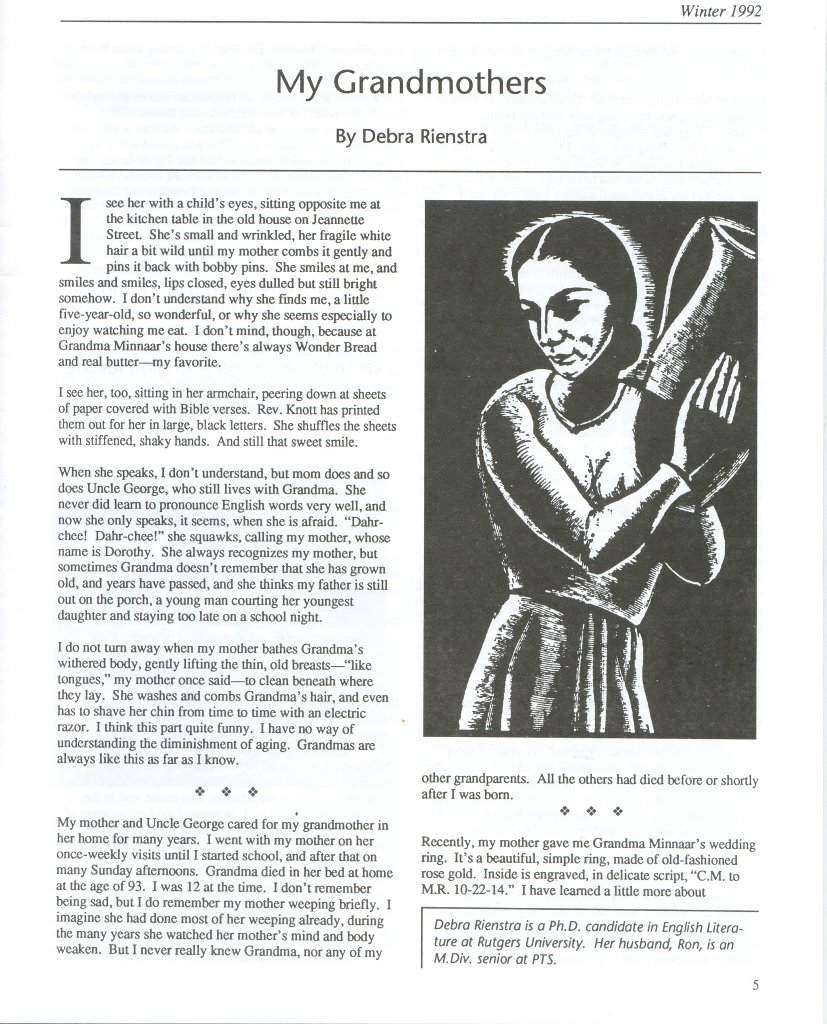
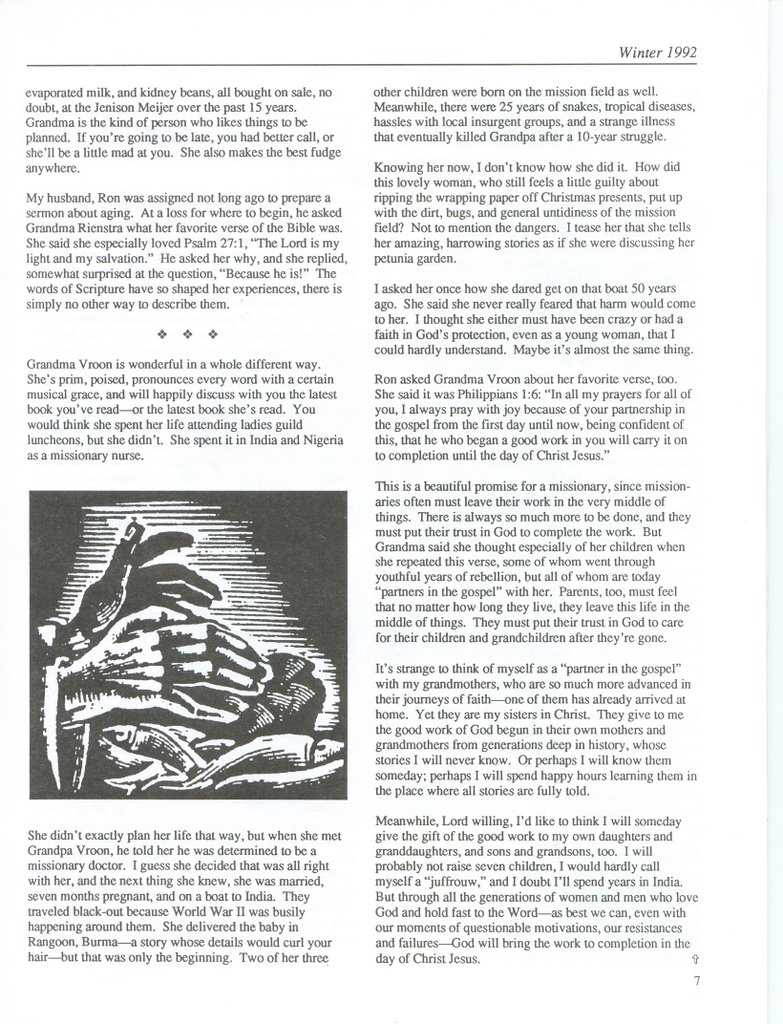
I was thinking about what a great woman she is when I remembered a piece Debra wrote 15 years ago (the last time I was in grad school!) for a Princeton Seminary community publication called Testament. It's about grandmothers -- Debra's own, and the two she inherited when she married me. I looked it up in our files, and thought it deserved to see the light of day again, in honor of one great Grandma. (Click on the thumbnails for a readable size .jpg file.)


My one ambition for my old age is to be a church lady. Not the kind who has turned bitter, complaining, and judgmental, but the kind who has grown nearer to wisdom and peace. I will be the lady in the same pew (or whatever we sit on by then) every Sunday, and I'll know all the little kids' names. I'll show up at the potlucks and volunteer to tutor the neighborhood kids. I'll sing loudly even though the people standing around me will secretly wish I had retired my voice years ago. Mostly I will pray, pray for people even when they haven't asked for prayer.
-- Debra Rienstra, So Much More, p. 181

Wednesday, July 26, 2006

Membership Requirements

In preparation for writing a paper next week, I've been doing some thinking these days about church membership. In a previous post, I remarked -- in a tangential sort of way -- about the sorts of professions that the early church saw as incompatible with living a Christian life (prostitute, musician, soldier, etc.), and wondered what sorts of professions we might put on that list today. Lately I'm wondering if the church would have the disciplinary wherewithal to make use of such a list even if we had one. If someone of the "wrong" profession wished to join, what church would or could say "We'd love to have you, but you'll have to make these significant changes before you can be part of us, starting (but not ending) with your job."

On the one hand, the gospel seems to mandate a rather inclusive attitude about belonging to the church. Jesus' circle was drawn with the wideness of God's mercy, encompassing many people who the offical religious leaders of his day rejected. On the other hand, what sort of group is it that expects and asks nothing of its members? That doesn't comport with the gospel either. Jesus talked about laying down one's life to follow him.

Some have articulated this tension by speaking about the "low stoop" but "long aisle" on the house of the church. It doesn't take much to get in the church, but it takes a while to walk up to the front and make the life-changing promises of discipleship to Jesus. Different church traditions seem to emphasize these two sides of the coin, with infant baptizers focusing on the low stoop, and those from the anabaptist traditions emphasizing the long aisle. But of course, in whatever Christian tradition, both these elements should find some expression.

As I was thinking about all this, I uncovered a piece of paper while doing some archeological research in an old basement file cabinet. It is a list of the steps down the aisle that were once part of my home church's membership process, way back in the day when I first got married and Debra and I joined the church together. The document is entitled "Joining (CHURCH NAME HERE): Steps toward Assimilation."

It includes a checklist with the following items:
  • Attend membership inquiry class (three sessions)
  • Attend council meeting (the governing board of the church)
  • Attend committee meeting
  • Attend fellowship event
  • Meet with the pastor
  • Meet with district council member
Whew!

It also provides some well-written rationale for these requirements (to be introduced to a broader segment of the church than you could come to know during worship services alone; to find ways to use your unique abilities within our congregation), and encourages potential members to see the "requirements for membership not as hurdles to be jumped, but as steps toward fuller participation in the life of the church."

I wonder what the membership process is like these days at my home church.

Or at yours.

And I wonder whether the requirements -- if there are any -- have more to do with the perpetuation and health of the institution, or with the steps individuals and groups need to take to become more Christlike. And whether those two things should seem like such radically different categories.

"I wouldn't belong to any club that would have me as a member" -- Groucho Marx

Monday, May 08, 2006

Consumer Culture & the Catechumenate

I just finished reading a fascinating book: Dell deChant's Sacred Santa: Religious Dimensions of Consumer Culture. Part of why I read this book is for a class project, doing a cultural comparison between our own time and the 2nd- 4th centuries of the common era (see previous post here).

Against those who suggest that America is becoming more and more secular, deChant argues -- persuasively, I think -- that it is, in fact, more and more religious. But not in the traditional sense of religion as we understand it. We think of religion as a system that locates the ground of being in the transcendent realm. America's religion, deChant argues, is cosmological; the great force that must be understood through myth and appeased through ritual is not Nature, but the Economy. Yes, that's right. When you go buy something, especially to do your part as an American to buoy the economy, you are pouring out an oblation to the gods.

DeChant expertly (and humorously) identifies the "sacred" stories that are conveyed through film, TV, and mass media advertising; and the ritual activities we perform, i.e. watching sports on TV, going shopping at the mall, etc.

The field of religious studies always looks at the way communities of faith shape time. DeChant suggests that the primary way in which our culture shapes time is not the agrarian calendar (born of an ancient cosmological religiosity), nor the Christian calendar. Rather, he says, we have an entire economic calendar organized around economic festivals -- holy days where we are "liberated from the profane realm of work and production" and are ushered into the "sacred times and climes of uninhibited acquisition-consumption-disposal." As you might guess, the "Santa" holiday is the primary festival in this calendar (lasting for an entire month). The rest of the calendar, based on consumer spending rates throughout the year, includes the Major Holy Days of Valentine's Day and Easter, the Secondary Holy Days of Super Bowl Sunday, President's Day, the "Back-to-School" festival, and numerous minor holy days and feast days such as Memorial Day, Labor Day, and Halloween.

DeChant argues that our current society is much more like ancient urban/pagan societies where the sacred manifests itself "through diversity rather than uniformity, with rituals related to many gods and spirits that influence every apsect of daily life. Religion is not a separate realm within society, but an aspect of every cultural activity. To participate in culture is to be religious."

So whether we like it or not, aware of it or not, we are part of this culture and its explicitly religious dimension. A dimension, need we say it, that is decidedly un-Christian. The question then, for those who follow Jesus, is this: to what extent are we called to separate ourselves from this culture and its permeating pagan economic religiousity? To what extent must we reject these ritual activities that affirm trust in a god other than the One true God? To what extent must we as the Church form our communities through practices, stories, and understandings of time that are counter-cultural?

In the back of my head as I'm reading this book is a list of professions that the early church saw as incompatible with the life of discipleship to Jesus Christ. This list is found in the early 3rd century Apostolic Tradition of Hippolytus. These professions include many that were just part of everyday culture -- but because that everyday culture was thoroughly imbued with religious meaning, these occupations were seen as infected with idolatry: prostitutes and pimps, idol sculptors and painters, actors, teachers, gladiators, athletic trainers, musicians and dancers, magicians, hairdressers, fortune-tellers, soldiers, those in authority (wearing purple).

So after all this what I'm wondering is this: If the Church had a genuinely counter-cultural catechumenate process in place today, what sorts of professions would we deem incompatible with the life of discipleship to Jesus? If DeChant is right about the economic/cultural religion of America, what occupations are infected with the idolatry of the system? I've got some ideas. What are yours?

(By the way, do a click on the picture of the book to see it up close. Worth the paperback price by itself.)

Thursday, May 04, 2006

The side-effects of teaching Homiletics


I've been teaching homiletics at Fuller for a couple years now, and it's one of the most enjoyable things I do here. I was reminded of this again last night as I heard students in my Wednesday night class preach two outstanding sermons - one written under some personal duress. Both sermons were thoughtful, practical, honest; they stayed close to the text, and were filled with carefully considered, imagination-shaping language. And then the students had some insightful things to say in critique of their own (and each others') work as we discussed the sermons in the second part of class. More often than not, this is my experience here, and it gives me hope for the church.

Hope which is not always confirmed in my Sunday sojourns to various SoCal churches. Not so many weeks ago our family went to a culturally significant megachurch. Much of the service was quite good (and as a bonus, we heard one of my favorite gospel singing groups, Take Six). While the sermon itself (the primary pastor was not preaching) was well-delivered, I was troubled by the persistent transactional language used to describe our relationship with God. We give our lives to God (by saying the Jesus prayer), and God gives us eternal life. The pastor very much wanted, at the close of his message, to seal the deal. It's salvation as understood by a community shaped by consumerist values.


Troubling as that was, it was nothing compared to what we experienced a few weeks ago at a prominent Pasadena church, where I endured 30 minutes of a talk (I can't even call it a sermon) before I did something I've never done before: I walked out right in the middle. It was apparant from the outset that the preacher was going to avoid actually preaching -- he telegraphed his homiletical theology in his preparatory prayer by asking that God bless "this little bit of information to help us live better lives this week." That's what a sermon is? Not the living Word of God? Not the presence of Jesus Christ? Just "a little bit of information?" Anyway, I decided to listen hard for what God wanted to say to me just the same. After a half-hour of scripture-neglecting, simplistic self-help slop, targeted to a very small demographic sliver of those assembled, what God said to me was "you should be pretty angry that my hungry people, who come here to be fed, get this instead." I sat there getting more and more steamed as the preacher kept jabbering on, until I finally realized that sitting there was doing me more spiritual harm than good. So I gathered up the kids (who had completely zoned out), and went to the car. We listened to Prairie Home Companion on the way home. It wasn't church, but it was better for our souls.

(The picture, by the way, is entitled "St. Peter Preaching." Note the two snoozers in the first row, and the fellow in the back whose eyes are lifted to heaven as if to say "Help him, Jesus." Hmmm. Maybe sub-standard preachers (and preachees) are not an altogether new thing.)

Tuesday, April 18, 2006

That's why we're number one!

All the nations of the earth are, I'm sure, duly impressed with American design engineers, who continue to advance human civilization. Why, our ketchup dispenser technology alone puts us far ahead of other, more backward nations.

But after seeing a commercial on TV last night for the new Oral-B Battery-operated Pulsar Toothbrush, we have to wonder: Maybe it's time to check "improving toothbrushing technology" off the world's to-do list.

I mean -- fifteen patents for this thing? Micro-pulsing? Does it do your taxes, too? You know, a person can simply move his or her hand back and forth with a regular toothbrush. It works fine.

Toothbrush design engineers of the earth, it's time to move on. How about applying your brilliance to solving a few other niggling little problems? Potable water for the world's poor? Cheap, clean energy? Repairing the ozone layer?

Anyone?

Sunday, April 02, 2006

Ancient-Future Faith

One of my classes this quarter is taking an interesting tack as we are sailing the waters of Liturgical History. We're exploring and testing Robber Webber's thesis, most clearly articulated in his Ancient-Future Faith, that the second, third, and fourth centuries of the Christian church offer the closest cultural parallels to our own time; thus, we may find the best resources for renewing the church's worship today in the worship of the earliest Christians.

One of the ways we're testing that hypothesis is by learning what we know about Christian worship in those early centuries. Lots of work in primary sources, guided by a monster bibliography and Paul Bradshaw's The Search for the Origins of Christian Worship.

What we'll find I'm not yet sure. But what I'm wondering at the outset is whether or not Webber's attempt to find resources from the second, third, and fourth centuries is really because those centuries are the most similar to the twenty-first in the cultural features that matter most. Or perhaps Webber's is another of the many attempts throughout history to find in the supposedly "golden" age of the Church ground and authority for the reforms one wishes to pursue in the present day. But if that's the motivation, we should return to the practices of the earliest church as reflected in Scripture, right? Anyone want to read through Corinthians and offer some suggestions for renewing the church today? Which of the practices found there should we imitate? Widespread dissention? Drunken fights at the Eucharist? Eating meat sacrificed to idols? Incestuous marriage?

Friday, February 24, 2006

Boundlessly Stupid

My friend Bethany Keeley rants on her blog about an article she read in the Focus on the Family webzine, “Boundless.” This ‘zine is aimed at “single adults,” and touts itself as as a place to explore “love beyond sex, faith beyond sociological stereotypes, and ideas beyond the politically correct.” It does not say anything about exploring (or embracing, as the article does) gender essentialism beyond question, historical generalizations beyond research, and conclusions beyond logic.

I loved Bethany's critique. But I also thought her words were too measured, too generous, too charitable to be called a “rant.” When you're in academia, and you're in a fight worth fighting, you need to bring it. Bethany is a first-rate grad student in communications, but she's also in her first year. I give her another six months before she's learned the true grad school art of opening up a big can of rhetorical whup-a**.

Two further comments. First, I was astonished to read that Maken was a lawyer before the end of her “involuntary servitude to singleness.” Don't they teach logic or research or history any more in law school? I was reading the piece aloud to Deb last night -- the kids were in the room, too, working on craft projects. We were howling in laughter as Jacob picked up on our real-time critique, and whenever Maken made sweeping and unsupported generalizations like “…past generations of Christians…” or “the purposes of marriage were uniformly understood…” or “Today’s singleness is either a lifestyle option or purely circumstantial; therefore it is largely unbiblical,” he would grab a piece of red paper from the craft project he was working on and wave it aloft, as if to say: “Red flag! Warning! Crashing non sequitur ahead! Caution! Facile conclusion just off the starboard bow!”

Second, I am dismayed that anyone is slurping up this stuff. Debra has been giving talks lately at Christian colleges – sometimes solo, sometimes with me along – on issues of feminism and family and career and vocation. Our hearts hurt for the good and godly young people at these places who uncritically accept the Dobsonian party line on “family values.” And our hearts are also proud of places like Calvin College, in whose educational fire God shapes thoughtful young women like Bethany. You go girl! Bring it!

Saturday, January 21, 2006

Alien Transmission from planet Academic Obfuscation

I was reading David Tracy's Analogical Imagination this week for my Theology & Culture class. It's a book on theological method; Tracy is particularly concerned with the place of theology as a discipline within the broader academy, especially in a radically pluralist world like our own.

He's got lots of good stuff to say about meaning-laden cultural "classics," and especially, as one might guess, about the analogical imagination and how similarity-in-difference is the key to opening up theological insight. Still, I'm not sure in the end he offers anything more than a really, really open-minded and civil tolerance of other viewpoints while maintaining a firmly modernist position on Truth as finally and ultimately revealed in the Christ-event. (Not that there's anything wrong with that).

Anyway, like many University of Chicago folk, he writes with an incredibly specialized vocabulary, in thick convoluted prose that seems intended to obfuscate rather than clarify -- or at least it seems to me. But that may just be me.

The last time I encountered stuff like this, from Don Browning in my Practical Theology class, I was pursuaded that there were two possible explanations for my cluelessness. One was that I was in way over my head, and these guys were writing about SERIOUSLY deep stuff, and I wasn't ready to swim in that end of the pool. The other option was that these guys -- how else to put this -- just can't write. I don't know - maybe they get bonus academic brownie points for not being understood. Maybe you don't get tenure if your review committee comprehended more than half of your latest monograph.

Of course, as anyone learns in grad school, the two options mentioned above (they can't write/I can't read) are not mutually exclusive -- there might be elements of truth in both of them.

So I have found helpful when reading such thick stuff to try to summarize each paragraph in my own words. Fortunately, this was precisely the task before me: to write a précis on Tracy for our class. (By the way, the word "précis" is a perfectly wonderful academicism).

So here are two sample sentences, taken from p. 447, and then my decoding of same:

Tracy:
The need for conversation -- expressed in the differing strategies of confrontation, argument, conflict, persuasion, and above all, concentration on subject matter -- should free the theologian to the fuller contemporary possibility of an analogical imagination. Under the rubric of a comparative and critical hermeneutics, the real similarities and dissimilarities, the continuities and discontinuities present in the contemporary pluralist situation should be allowed their necessary emergence.

Rienstra:
Keep talking. Keep thinking. But ya'll can disagree. It's all good.

(Thanks to my friend Chip Andrus for the southern influenced inflection).