Showing posts with label Fuller. Show all posts

Tuesday, January 15, 2008

Ph.D. "Candidate"

Whoo-hoo, it's time to Ce-Luh-Brate!!

I have received official word that I passed my comprehensive exams!

That means I'm A * B * D , baby!

(That's "all but dissertation" for those of you who haven't endured the torture.)

A big shout-out to to all of you who:
  • kindly asked how the studying was going
  • were extra special nice to me during November and December
  • helped Deb out with managing the kids and household while I was "in seclusion"
  • put up with mood swings from despair to elation, etc.
  • lent me obscure theology books or assured me that the one I was looking for wasn't that important anyway
I'll now be engaged in a week's worth of celebration -- said celebration consisting mostly of crossing household-chore-type items off to-d0 lists that have accumulated since 2004. Anyone wanna come over for a seriously fun "replace the utility sink" party?

Friday, January 11, 2008

Whew!

Evidently, we have discovered the line of preoccupation beyond which blogging does not occur. It's a line formed by Ph.D. comprehensive exams and shaded with a major public lecture situation.

But all that is over now! Ron spent November and much of December up to his elbows in esoteric theology books and up to his eyebrows in esoteric theological thoughts. He completed the comprehensive exams the Friday before Christmas. Still haven't heard back yet on whether he passed them all, but we're cautiously optimistic, and we'll post news here as soon as we have it.

Meanwhile, he prepped for two intensive classes on Worship and Homiletics that he's in the midst of teaching right now at WTS, and he completed an adult education curriculum for the CRC on worship. Not entirely sure how that got done by the deadline (December 16), but a bit of help from me and the promised financial bonus for on-time delivery no doubt had something to do with it.

Meanwhile, I spent Christmas break preparing to teach interim and to give a January Series lecture. The lecture happened yesterday. Thankfully, it went fine, at least according to some witnesses of possible extreme bias. It's hard for me to know, truly, as the whole thing felt rather like an out-of-body experience. I can say that the Calvin staff was at their best: organized, hospitable, cheerful. As someone once remarked about Calvin, "the place runs like butta." That's often absolutely true. I hope all our guest speakers feel as welcome and appreciated.

I also found out just how kind and supportive my good friends and colleagues can be. I have a lot to be thankful for.

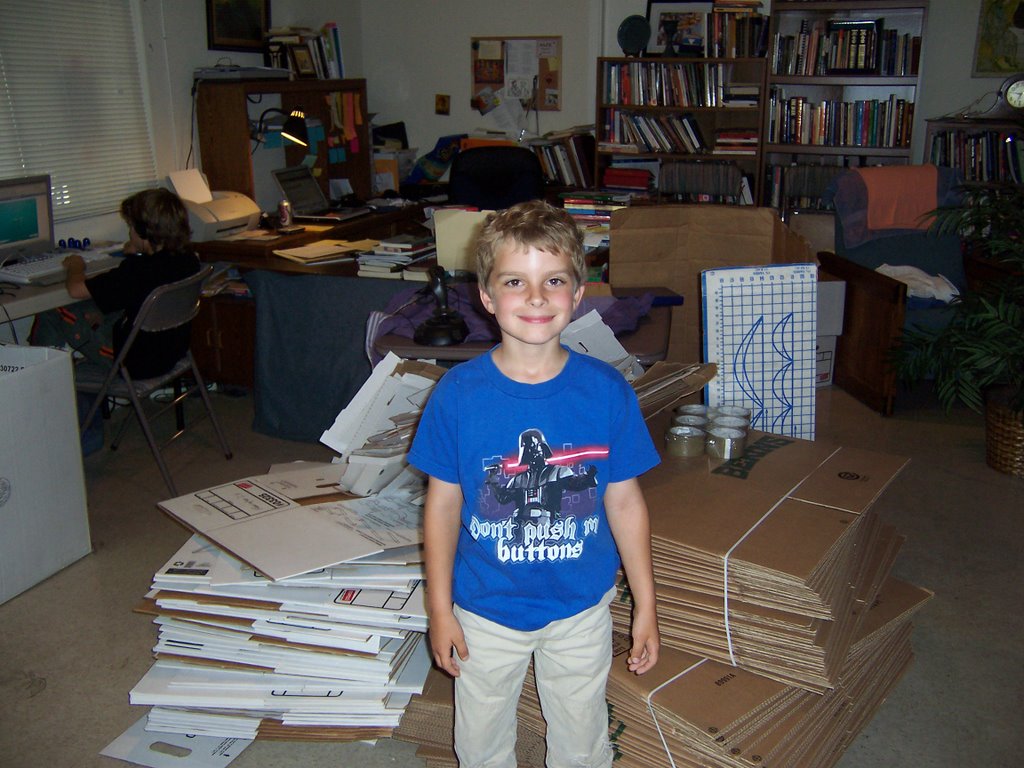
Let's see: what else? Sometime in the last few weeks Christmas happened, too. I think. Not entirely sure, actually. It's all a blur. Hmmm. Well, we do have photographic evidence that Miriam, Philip, and Ron played key, bathrobe-style roles in our church's Christmas Eve pageant. Miriam made for a very blonde, blue-eyed Mary. Philip played the young Jesus (for which he was gleefully teased by his siblings--"What would Philip do?" etc.). Ron drew upon his seminary memories of certain professors and convincingly portrayed the wicked King Herod. Thankfully, Jacob and I just lurked among the musicians, playing our instruments along with the hymns.

So at last, after all that, life slows down a bit and we're back to just work and school and the usual round of soccer and church stuff. Poor Jacob finally got a haircut yesterday after a month of looking like David Cassidy circa 1974 after misplacing his mousse and blowdryer.

Oh, in other news, Ron has at last succumbed to two years of propaganda (the result of my politics of food class) and become a food zealot. Michael Pollan's new book, In Defense of Food, toppled him over the edge. The children are completely dismayed. Now it's not just Mom making snide remarks about high-fructose corn syrup. Now Dad is constantly asking "Would your great grandmother recognize that as food?" and writing things like "organic chickpeas" into our family menu.

That about catches us up, I guess. Now back to our usual blogging on random nutty ideas and insignificant news items.

Wednesday, March 07, 2007

Gaudiamus Igitur


Consumatum est. I took my Latin final today.

How'd I do?

Let me just say: veni vidi vici bootay (or would it be declined boot-am? Well, quem cura.)

We're thinking of having a toga party this weekend to celebrate, based on a friend's dictum. Crank up the tunes! Gaudeamus Igitur!

Sunday, February 25, 2007

Complexifying the Liturgy

After giving a worship workshop this past weekend in New Jersey, and lecturing the week before that on liturgical ordo, I have been thinking some about the ways in which structure the elements in our worship services -- why we put in the elements we do, and why we order them in a particular way.

This led me to remember an article I wrote last year while at Fuller seminary, about experimenting with the worship ordo of our All-Seminary Chapel services.

We were struggling with three related problems: liturgical boredom, thematic coherence, and sacramental expectation. To summarize, our default liturgical structure was on the simplistic side: 20 minutes of singing (led by a group from the right hand side), followed by a sermon (preached by a professor from the left hand side). In addition, it was hard to give that "singing time" any focus because we often didn't learn what the professor/preacher was going to talk about in enough time to do anything about it. Finally, both the singing and sermon time became freighted with sacramental expectations that neither could regularly meet.

Our experimental solution was to borrow a simple worship pattern from the rites of daily prayer. Those rites were developed long ago as the devotional times used by monks and academics in the precursors to our universities and seminaries. We divided up our time together into four categories, mnemonically remembered as "Praise / Psalm /Proclamation / Prayer." We found this pattern most helpful for a number of reasons...

But exactly how it did that is a bit too much for this family blog. Instead, check out WorshipHelps, where I've re-posted the whole thing.

Sunday, January 28, 2007

Connections

Once again the three-ring circus that is the Symposium on Worship has concluded. After six worship services, a dozen presentations, and countless encouraging and stimulating conversations with people doing and teaching and loving worship, Debra and I are both exhausted.

One of the best parts of Symposium is that because so much is going on, it is a hot house for serendipitous connections: connections between gospel music and liturgical dance; between the cruciform glory of God and alternative worship practices; between old and new friends.

Some of this year's highlights included a fun Friday night at a local brew joint with a collection of our favorite Fuller folk (and honorary Fuller folk): Clay Schmit, Fred & Dottie Davison, Luke Hyder, Todd Farley, Chuck Fromm, Mary Hulst, and Eric Jacobsen. Whatever else you say about folks in California, manifesting the eschatological joy of the kingdom (i.e. partying) comes a bit easier to them than it does to us dour and frozen Midwestern Calvinists. We don't really deserve to enjoy ourselves, we think.

Deb presented on her/our recent work on words in worship; I presented on developments in the emerging/alt church.

I think my presentations went well, but suffered from their context. That is to say, the fellow presenting just before me was Doug Gay. His topic was similar to mine (he's one of the authors, in fact, of the book on alternative worship, titled Alternative Worship). Add to this the fact that he was brilliant, charming, tall, and... to top it all off, Scottish. So he spoke brilliantly and charmingly from on high about "Altairnative Woarship" while I followed him speaking competently, if nasally, a bit closer to the ground, about "Alternutive Wuurrship." Fortunately, I had a lot of pictures in my presentation.

Even more fortunately, Doug had some free time when Symposium concluded, so he came to church with us yesterday morning, and then came over for brunch. Another serendipitous connection between two practitioners and thinkers that is now a connection between friends.

Friday, November 10, 2006

Amo Augustinum

OK, it's kind of a pain learning another language at my advanced age, but as I'm studying for my Latin exam (the last step before I take my comprehensive exams), I'm realizing some interesting things. Among them: Augustine was a pretty fair writer.

Here's a choice couple sentences from the Confessions III.i

Veni Carthaginem et circumstrepebat me undique sartago flagitiosorum amorum. Nondum amabam et amare amabam et secretiore indigentia oderam me minus indigentem.

Even if you even if you wouldn't know an imperfect indicative if it bit your nose; even if you don't catch the subtle pun between Carthago (Carthage) and sartago (frying pan); even if you don't really understand what he's saying, even after you've translated it,* it's still undeniably cool word-work.

And I'm just geeky enough to think it's pretty cool that I'm learning to appreciate some 1600-year old rhetorical artistry -- artistry and appreciation both offered in service of the one God who is, according to the Bible, Love.


*Literal: I came to Carthage, and (there) crackled on on all sides of me a cauldron of shameful loves. I did not yet love, but I loved to love, and
(from) a secret want, I hated myself wanting little.

Less literal:
I came to Carthage, and on on all sides of me frizzled a frying pan of shameful loves. I was not yet in love, but I was in love with love; and (from) a secret want, I hated myself in want of wanting.

OR ... from a hidden hunger, I hated myself for my small hungering.

Wednesday, July 26, 2006

Membership Requirements

In preparation for writing a paper next week, I've been doing some thinking these days about church membership. In a previous post, I remarked -- in a tangential sort of way -- about the sorts of professions that the early church saw as incompatible with living a Christian life (prostitute, musician, soldier, etc.), and wondered what sorts of professions we might put on that list today. Lately I'm wondering if the church would have the disciplinary wherewithal to make use of such a list even if we had one. If someone of the "wrong" profession wished to join, what church would or could say "We'd love to have you, but you'll have to make these significant changes before you can be part of us, starting (but not ending) with your job."

On the one hand, the gospel seems to mandate a rather inclusive attitude about belonging to the church. Jesus' circle was drawn with the wideness of God's mercy, encompassing many people who the offical religious leaders of his day rejected. On the other hand, what sort of group is it that expects and asks nothing of its members? That doesn't comport with the gospel either. Jesus talked about laying down one's life to follow him.

Some have articulated this tension by speaking about the "low stoop" but "long aisle" on the house of the church. It doesn't take much to get in the church, but it takes a while to walk up to the front and make the life-changing promises of discipleship to Jesus. Different church traditions seem to emphasize these two sides of the coin, with infant baptizers focusing on the low stoop, and those from the anabaptist traditions emphasizing the long aisle. But of course, in whatever Christian tradition, both these elements should find some expression.

As I was thinking about all this, I uncovered a piece of paper while doing some archeological research in an old basement file cabinet. It is a list of the steps down the aisle that were once part of my home church's membership process, way back in the day when I first got married and Debra and I joined the church together. The document is entitled "Joining (CHURCH NAME HERE): Steps toward Assimilation."

It includes a checklist with the following items:
  • Attend membership inquiry class (three sessions)
  • Attend council meeting (the governing board of the church)
  • Attend committee meeting
  • Attend fellowship event
  • Meet with the pastor
  • Meet with district council member
Whew!

It also provides some well-written rationale for these requirements (to be introduced to a broader segment of the church than you could come to know during worship services alone; to find ways to use your unique abilities within our congregation), and encourages potential members to see the "requirements for membership not as hurdles to be jumped, but as steps toward fuller participation in the life of the church."

I wonder what the membership process is like these days at my home church.

Or at yours.

And I wonder whether the requirements -- if there are any -- have more to do with the perpetuation and health of the institution, or with the steps individuals and groups need to take to become more Christlike. And whether those two things should seem like such radically different categories.

"I wouldn't belong to any club that would have me as a member" -- Groucho Marx

Friday, June 02, 2006

Prof. Pay Day!

None of the official Fuller curriculum-guidance documents require a final exam for any of classes I taught this quarter (Homiletics, Worship Theology & Praxis, Crafting Language). So I haven't given any. It ends up being a win-win: My students don't want to take one, and I don't want to write or grade one.

But there is a huge payoff, I discovered this week, to doing some sort of end-of-the-quarter assessment. That payoff is in finding out whether or not my students have learned anything in the past 10 weeks -- well, more specifically, whether anything they learned had anything to do with what I hoped they might learn.

And the miraculous, grace-filled answer is that they did. Did they ever! I spent a few hours -- really precious hours, as it turns out -- prompting a course review in each class, and then listening to the students identify the things they found most valuable in our reading and writing and thinking and discussing and praying and sharing. Stuff I was sure had sailed in one ear and out the other instead came right back to me in better form than I gave it out. Book recommendations I'd made off the cuff turned out to catalyze all kinds of other things they were learning outside of our class. Seeds I planted (seeds I myself received from others) are starting to bloom and these folks showed me their gardens. Woot! It's a good crop!

I left my last class thinking about the rewards of teaching. Yep. That's why I'm doing this. Good to get a reminder once in a while.

Thursday, May 25, 2006

Award Week

Warning: This is a blatant boast-post. Please ignore if you hate this sort of thing.

It began on Tuesday night, at Jacob's orchestra concert. The elementary orchestra played--more or less in the keys of D and G Major--and a few students did solos. Granted, standards were not especially high. But when our boy sounded the first notes of his solo, it was fun to watch the other parents' jaws drop. Jacob played even better than he does at home, which might suggest the virtues of playing conditions that do not involve dishes clanking and little brothers running around.


Then, on Thursday, I attended the Fuller Seminary awards convocation. No big surprises here. I knew I had received a Brehm Fellowship since, well, that's how we've been paying my tuition all year. Still it was a nice occasion and I enjoyed getting some props from the be-robed Fuller faculty. That's me up there with President Mouw and my fellow Brehmmie, Eric Jacobsen. Really. It is. Stupid flash.


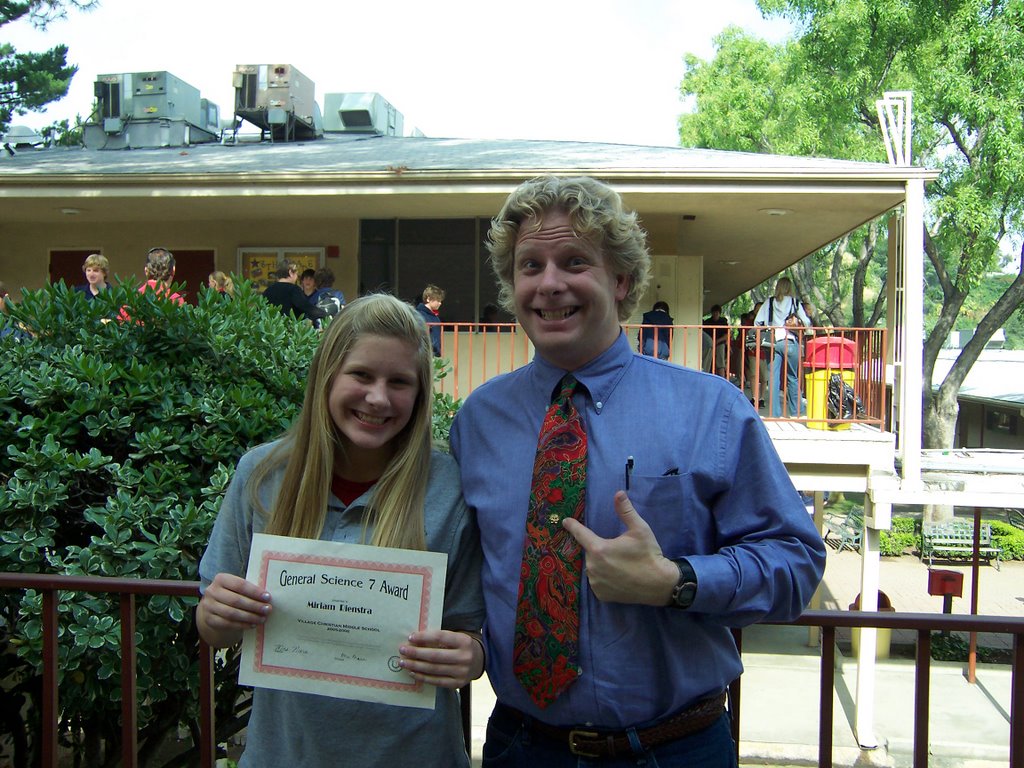
Next up: Mia. Friday morning at 8 a.m. was middle-school awards "chapel." It was less a chapel than an occasion on which middle schoolers could enjoy screaming and cheering for their classmates with impunity. Mia had no idea that she was getting an award, but fortunately, the school had notified her mom and dad, so we were there. To keep the secret from Mia, we had to come up with blatant lies about "having a meeting" that morning in order to explain why we were dressed and ready so early. Each teacher gave an award to one student in each subject in each grade level. Mia, all our geeky math-and-science friends will be happy to learn, got the seventh grade science award, and a shiny bit of atom-shaped bling-bling that I proudly wore as a tie-tack the rest of the day.

And last but not least, the rumors have now been confirmed. Deb's book So Much More was chosen by Christianity Today magazine to receive an Award of Merit for 2006 in the apologetics/evangelism category. Whoo hoo! It's great for Deb as a young whipper-snapper writer to be among a hoary assembly of authors the likes of N.T. Wright, Rowan Williams, Robert Wuthnow, Eugene Peterson, and other old white guys.

That's it this week. But Pip's award assembly is coming up soon. Last year he got best "Christian Attitude." Let's hope he's got the spiritual resources to deal with a) his insufferably self-pleased parents and siblings and b) a house whose current state of upheaval guarantees that the Rienstra family will win no housekeeping accolades anytime soon.

Sunday, May 14, 2006

Luke 14:23 or something like it

Our imminent departure from Southern California (only a few short weeks) is prompting us more and more to savor each day, and to note those moments that have a distinctive Sun Valley or Fuller flavor. Here's one from last week:

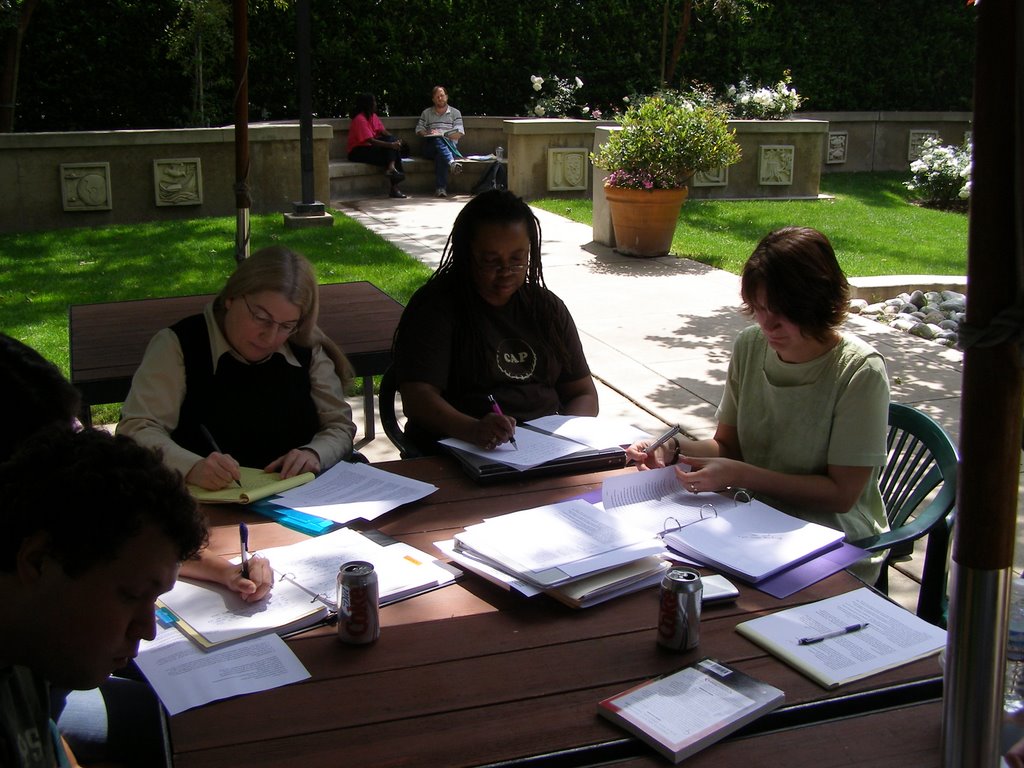
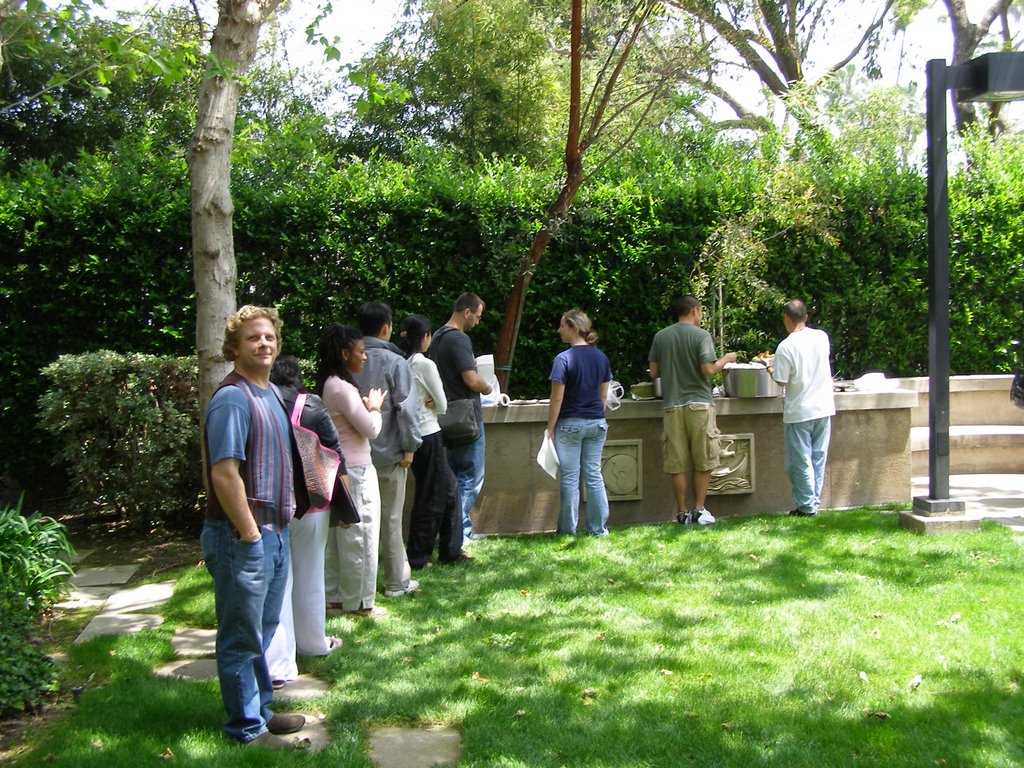
It was a gorgeous spring day in Pasadena last Thursday, and Debra and I decided to hold our class outdoors in Barker Commons. We had a lively discussion about prayer, and it seemed no one's attention was too distracted by the sights (and smells) of the nearby rose garden. It helped that the commons was mostly quiet during class. But as we concluded class, hungry seminary students began to gather noisily around us, forming a queue behind some gigantic kitchen pots. I hadn't noticed how those pots got there, but I knew what was up: it was a curry day. Woo hoo!

One of our wonderful librarians, BJ Dabhade, regularly cooks up gigantic pots of authentic Indian food. He sets them down in Barker Commons and then he wanders around the highways and byways of campus inviting demanding that folks come and eat what he has prepared.

"Come on!" he told our class, "You've got to eat something for lunch! There's plenty of food. Come on!"

We got in line, and after BJ offered a loud and enthusiastic grace, we enjoyed a meal of saffron rice, stewed vegetables, chicken curry and excellent fellowship. All flavored with a hint of eschatological feasting.

Monday, May 08, 2006

Consumer Culture & the Catechumenate

I just finished reading a fascinating book: Dell deChant's Sacred Santa: Religious Dimensions of Consumer Culture. Part of why I read this book is for a class project, doing a cultural comparison between our own time and the 2nd- 4th centuries of the common era (see previous post here).

Against those who suggest that America is becoming more and more secular, deChant argues -- persuasively, I think -- that it is, in fact, more and more religious. But not in the traditional sense of religion as we understand it. We think of religion as a system that locates the ground of being in the transcendent realm. America's religion, deChant argues, is cosmological; the great force that must be understood through myth and appeased through ritual is not Nature, but the Economy. Yes, that's right. When you go buy something, especially to do your part as an American to buoy the economy, you are pouring out an oblation to the gods.

DeChant expertly (and humorously) identifies the "sacred" stories that are conveyed through film, TV, and mass media advertising; and the ritual activities we perform, i.e. watching sports on TV, going shopping at the mall, etc.

The field of religious studies always looks at the way communities of faith shape time. DeChant suggests that the primary way in which our culture shapes time is not the agrarian calendar (born of an ancient cosmological religiosity), nor the Christian calendar. Rather, he says, we have an entire economic calendar organized around economic festivals -- holy days where we are "liberated from the profane realm of work and production" and are ushered into the "sacred times and climes of uninhibited acquisition-consumption-disposal." As you might guess, the "Santa" holiday is the primary festival in this calendar (lasting for an entire month). The rest of the calendar, based on consumer spending rates throughout the year, includes the Major Holy Days of Valentine's Day and Easter, the Secondary Holy Days of Super Bowl Sunday, President's Day, the "Back-to-School" festival, and numerous minor holy days and feast days such as Memorial Day, Labor Day, and Halloween.

DeChant argues that our current society is much more like ancient urban/pagan societies where the sacred manifests itself "through diversity rather than uniformity, with rituals related to many gods and spirits that influence every apsect of daily life. Religion is not a separate realm within society, but an aspect of every cultural activity. To participate in culture is to be religious."

So whether we like it or not, aware of it or not, we are part of this culture and its explicitly religious dimension. A dimension, need we say it, that is decidedly un-Christian. The question then, for those who follow Jesus, is this: to what extent are we called to separate ourselves from this culture and its permeating pagan economic religiousity? To what extent must we reject these ritual activities that affirm trust in a god other than the One true God? To what extent must we as the Church form our communities through practices, stories, and understandings of time that are counter-cultural?

In the back of my head as I'm reading this book is a list of professions that the early church saw as incompatible with the life of discipleship to Jesus Christ. This list is found in the early 3rd century Apostolic Tradition of Hippolytus. These professions include many that were just part of everyday culture -- but because that everyday culture was thoroughly imbued with religious meaning, these occupations were seen as infected with idolatry: prostitutes and pimps, idol sculptors and painters, actors, teachers, gladiators, athletic trainers, musicians and dancers, magicians, hairdressers, fortune-tellers, soldiers, those in authority (wearing purple).

So after all this what I'm wondering is this: If the Church had a genuinely counter-cultural catechumenate process in place today, what sorts of professions would we deem incompatible with the life of discipleship to Jesus? If DeChant is right about the economic/cultural religion of America, what occupations are infected with the idolatry of the system? I've got some ideas. What are yours?

(By the way, do a click on the picture of the book to see it up close. Worth the paperback price by itself.)

Wednesday, April 26, 2006

Bring Any Name

This quarter, Debra and I have been thoroughly enjoying teaching a class together here at Fuller. The title is "Crafting Language for Worship." We have a lively and engaged group of students, and we're both learning lots ourselves.

This week we're reading Brian Wren's What Language Shall I Borrow as our entry into the topic of God-language. It's a little dated, but very good for our purposes.

As we talk about the virtue of stretching our language for God beyond the boxes we commonly construct, I've wanted the class to sing some of Wren's hymn texts, which were composed precisely to increase linguistic elasticity in our sung prayer. The text he seems to like best is "Bring Many Names." It does, in fact, bring many names: Strong Mother God, Warm Father God, Old Aching God, Young Growing God.

But here's the thing: I find myself skittish about giving it to the class to sing during our worship time. That's because after five minutes of googling some extensive research, I've learned that this particular song has found its widest and most enthusiastic reception in Unitarian Universalist circles. Which leads me to wonder whether Wren's injunction to "bring many names" can be too easily misheard as permission to "bring any name."

I'm not sure the blogosphere is the best place to debate the fittingness or theological merits of this song or Wren's project, but... well, what do you all think?

Sunday, April 02, 2006

Ancient-Future Faith

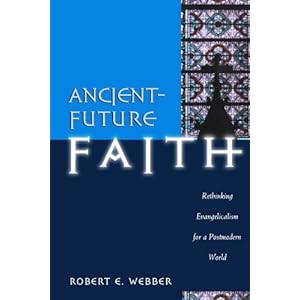
One of my classes this quarter is taking an interesting tack as we are sailing the waters of Liturgical History. We're exploring and testing Robber Webber's thesis, most clearly articulated in his Ancient-Future Faith, that the second, third, and fourth centuries of the Christian church offer the closest cultural parallels to our own time; thus, we may find the best resources for renewing the church's worship today in the worship of the earliest Christians.

One of the ways we're testing that hypothesis is by learning what we know about Christian worship in those early centuries. Lots of work in primary sources, guided by a monster bibliography and Paul Bradshaw's The Search for the Origins of Christian Worship.

What we'll find I'm not yet sure. But what I'm wondering at the outset is whether or not Webber's attempt to find resources from the second, third, and fourth centuries is really because those centuries are the most similar to the twenty-first in the cultural features that matter most. Or perhaps Webber's is another of the many attempts throughout history to find in the supposedly "golden" age of the Church ground and authority for the reforms one wishes to pursue in the present day. But if that's the motivation, we should return to the practices of the earliest church as reflected in Scripture, right? Anyone want to read through Corinthians and offer some suggestions for renewing the church today? Which of the practices found there should we imitate? Widespread dissention? Drunken fights at the Eucharist? Eating meat sacrificed to idols? Incestuous marriage?

Friday, March 17, 2006

Whoo hoo!

Ahh - there's nothing like finishing up a big ole project, handing it in, and heading off for a week's R&R. A friend of mine says you have to celebrate with at least as much enthusiasm and energy as you expended in earning the celebration. If that's the case, I should pretty much take the rest of the year off. A week will have to do. And probably will.

Tuesday, March 14, 2006

Last... week... before... vacation

Can't... stop... to blog.

Must keep to

Or, more to the point, to

Or most accurately, to

Thursday, March 02, 2006

The Great Chain of Being a Worship Wonk

I had a wonderful experience recently, finding myself one small link in a great chain of worship wonkedness. Here are a few of the key steps, though of course there are many links, both before and after the ones described here, about which we cannot fully know.
  • A friend, Chip Stam, makes a presentation on Keith Getty & Stuart Townend at the North American Academy of Liturgy meeting in San Diego.
  • My worship interns ask me to speak a little in class about using the first-person personal pronoun in worship songs.
  • I respond with a 15-minute mini-presentation on the objective and subjective in worship songs. I argue that while some people say there is too much "I" and "me" language in some genres (and they may be right), the Psalms -- the songbook of God's people with some authoritative precedent -- is full of those first-person pronouns. I suggest then, that those subjective "I"s are usually spoken in balance with and response to objective statements about who God is and what God has done.
  • During the presentation, I use some handy-dandy illustrative materials from Chip's Getty/Townend presentation to illustrate.
  • My interns plan chapel and decide to use the Getty/Townend song In Christ Alone. They also attend very carefully in other song choices to the balancing of the objective and subjective.
  • I have a conversation with a Fuller student who confesses that his extensive musical training has kept him in a perpetual state of disgust with "contemporary" (read "pop") church music. He has hated it, even as he has had to endure it regularly. Not long ago, however, he tells me that he attended a Fuller chapel service since he was playing percussion for the Fuller Vocal Ensemble. At that service, he was getting ready for his weekly wallow in disgust when he was struck by the fact that the particular "contemporary" worship songs sung that week not only "didn't suck," they were actually quite good - both lyrically and musically. The song that got his attention, of course, was Getty's In Christ Alone.
  • This experience catalyzed within him a desire -- stoked by another class he is taking in ethnomusicology here at Fuller -- to reconcile his 'high art' church-music self with his 'low culture' rock and roll self. He is rethinking the role of music and the various cultural languages with which we speak our praise and prayer in worship.
  • This student, by the way, is an excellent composer, and a fair writer. Who knows what happens next... Maybe he'll write the excellent songs my children will sing in worship in 20 years. And another link in the chain is forged.
Solo Dei Gloria.

Wednesday, February 08, 2006

Drama in Worship

An upcoming speaker for All-Seminary chapel here at Fuller has asked my interns to make use of drama in the worship service. So they asked me for a few pointers -- some do's and don't's, with theological underpinnings. I obliged with a discussion prompted by the following excerpt from something I'd written a while ago, and which I have just learned has been sent to the printers and so at this moment is being published. Hooray!

(For more info on this publication, see here and here.)

...[W]e need more drama. Not a light-hearted warm-up to the sermon, not a subtlety-deficient morality lesson – a good hard thwack in the ethics – but something that provokes and asks questions, that genuinely invites the congregation into a space where the text and our unique lives intersect.

Of course, all congregations use drama in worship. Scripture read with passion and intelligence is drama. A song that tells the salvation story is drama. Worship as a whole is drama. The best worship services, the best liturgies, are those that re-enact the drama of God and God’s people, traversing the contours of the covenant life. For that very reason, other “mini” dramas, inserted into the liturgy, can distract from the primary work of the people. Yet thoughtful, well-written drama can be used fruitfully in worship: to point out paradox or hypocrisy, to deepen confession, to give expression to anguish, to testify to unmerited grace. It can illumine places where the changeless Gospel intersects with our changing times. In a world becoming less literate and more oral and aural, drama is a powerful – and often overlooked – tool for proclaiming that Gospel.

... Still, the wise pastor will make sure that materials used in worship are reviewed by someone with theological discernment, who knows a good heresy when she sees one, who knows to avoid moralistic shlock and propagandistic screeds, who shuns the quick laugh and uninformed improvisation; someone who knows that part of the power of drama in worship is its poetic character, the concentrated, careful use of words – always in service of the One Word.


Tuesday, January 24, 2006

Hardware Drives Software: Technology & Music in Worship

Last week I finished writing a piece for Fuller Seminary's 3x-yearly magazine of theology & commentary, Theology News & Notes. This particular issue's theme is the place of music in worship, and I was asked to contribute a piece on the effect of technology on worship music. My thesis, simply put, is a truism borrowed from the computer industry -- hardware drives software:

As the church seeks to make the most of certain hardware technology – amplification, lyric projection, and looping DJ software, for example – we can expect that our worship software, i.e. the style of our worship itself, will also change. It may expand in potentially wonderful and creatively enculturated new ways, following the leading of the Holy Spirit. Or it may be narrowed in ways that are hip, but historically, and even theologically, suspect.

The article then examines the three aforementioned technologies, pointing out the good and the bad, the helpful and the heinous.

The idea for the piece arose arose out of a seed of an observation about hardware and software and the composition of some contemporary worship songs:

I have begun to see signs that some songs are being composed, perhaps unconsciously, not just to take advantage of the technology, but bounded by its peculiar limitations. The structure of the songs and the shape of the melodies are being molded to fit the size of the screen and the super-sized words projected onto it. Thus, we no longer get lyrical lines of melody and text; we get textual phraselets and melodic motifs -- mere musical fragments, not bearing repetition, but repeated nevertheless. And repeated.

A good example is the song “My Glorious” by Martin Smith and Steward Garrard....

Lest I appear a Luddite here, I hasten to add that in the article I have many good things to say about amplification, projection, and yes, DJ looping software. But I am concerned that we are less discerning than we might be. I challenge you, for example, to visit this website and find a single theological insight brought to bear on the use of technology in worship. Sigh. There's a lot of work to be done.

I am quite interested in hearing from my fellow WorshipWonks who read this blog: what effects on worship style/software do you see as a result of the church's adoption/adaptation of certain hardware technologies?

Saturday, January 21, 2006

Alien Transmission from planet Academic Obfuscation

I was reading David Tracy's Analogical Imagination this week for my Theology & Culture class. It's a book on theological method; Tracy is particularly concerned with the place of theology as a discipline within the broader academy, especially in a radically pluralist world like our own.

He's got lots of good stuff to say about meaning-laden cultural "classics," and especially, as one might guess, about the analogical imagination and how similarity-in-difference is the key to opening up theological insight. Still, I'm not sure in the end he offers anything more than a really, really open-minded and civil tolerance of other viewpoints while maintaining a firmly modernist position on Truth as finally and ultimately revealed in the Christ-event. (Not that there's anything wrong with that).

Anyway, like many University of Chicago folk, he writes with an incredibly specialized vocabulary, in thick convoluted prose that seems intended to obfuscate rather than clarify -- or at least it seems to me. But that may just be me.

The last time I encountered stuff like this, from Don Browning in my Practical Theology class, I was pursuaded that there were two possible explanations for my cluelessness. One was that I was in way over my head, and these guys were writing about SERIOUSLY deep stuff, and I wasn't ready to swim in that end of the pool. The other option was that these guys -- how else to put this -- just can't write. I don't know - maybe they get bonus academic brownie points for not being understood. Maybe you don't get tenure if your review committee comprehended more than half of your latest monograph.

Of course, as anyone learns in grad school, the two options mentioned above (they can't write/I can't read) are not mutually exclusive -- there might be elements of truth in both of them.

So I have found helpful when reading such thick stuff to try to summarize each paragraph in my own words. Fortunately, this was precisely the task before me: to write a précis on Tracy for our class. (By the way, the word "précis" is a perfectly wonderful academicism).

So here are two sample sentences, taken from p. 447, and then my decoding of same:

Tracy:
The need for conversation -- expressed in the differing strategies of confrontation, argument, conflict, persuasion, and above all, concentration on subject matter -- should free the theologian to the fuller contemporary possibility of an analogical imagination. Under the rubric of a comparative and critical hermeneutics, the real similarities and dissimilarities, the continuities and discontinuities present in the contemporary pluralist situation should be allowed their necessary emergence.

Rienstra:
Keep talking. Keep thinking. But ya'll can disagree. It's all good.

(Thanks to my friend Chip Andrus for the southern influenced inflection).