Showing posts with label Faith. Show all posts

Wednesday, December 10, 2008

Advent Stuff

December is a difficult month for those of us who have an uneasy relationship with stuff.

Family and friends ask, “What do you want for Christmas?” and we’re supposed to have to hand a list of things we’d like to own, but don’t really need. A sweater, or electronic gew-gaws, or maybe a kitchen widget. The things on the list can’t be too expensive, or too luxurious, lest one appear greedy and craven. Nor can they be too common, lest one appear needy (or, in an insult to the consumer gods, indifferent). And of course, the gift ideas have to be real – you can’t tell your sister who drew your name out of the hat at Thanksgiving that what you really want is for all the children of the world to join hands and sing together in a spirit of harmony and peace. For some reason, family members tend to scoff at holier-than-thou gift requests.

Meanwhile we struggle: Should I want anything? Aren't I filthy rich already by world standards? Does giving away end-of-the-year donations balance out the stuff under the tree? Aren't we supposed to be using this time of year to not to get-get-get, but to get rid of stuff, to empty our homes and hearts to make room for Christ's coming?

So it has been good during this season to think a bit more deeply about stuff. We had opportunity to do so this past week through some correspondence with good friends of ours, faculty at Westmont College in Santa Barbara, who lost their homes and (nearly) all their worldly possessions in the California Tea Fire.

Academic goobers that we are, we grieve with them especially for the loss of their books. We know that books are like good friends who shape your soul, whose company you enjoy repeatedly and whom you long to introduce to others. Losing them is a big deal.

We all have our stuff-fetishes, the physical objects that we cling to most tightly. Perhaps one of the hardest spiritual tasks for this season is to remember that no thing is permanent, nothing is ultimately ours. We can hold our stuff with gratitude and appreciation, but we have to hold it lightly. Our friend Lisa De Boer--one of those Westmont faculty who lost her home in the fire--wrote this to us about a discussion she had with her students once classes resumed after the fire:

I was teaching about Gothic cathedrals this morning, and a student asked if workers ever died, falling off the scaffolding of a cathedral. Well, the short answer is “yes, of course they did.” The longer answer involved taking a poll of students who had ever had a serious infection, or an appendectomy, or any other illness that could easily have led to death…naming the number of medieval occupations that involve regular hazards to health, life and limb…and talking about general life expectancies.

Our assumption that we will have a long and healthy life is so strange and modern. So is our assumption that our homes are durable and our possessions really ours. How many people in earlier ages and even today, haven’t been burned out of their homes in war or disaster and have had to pick up again, often in a different city or country, with no insurance and very few supports?

While I do feel and grieve my loss, there is also a strange “lightness of being” that I experience at times, of being just a bit more aware of my basic humanity—minus the trappings—than I was before.


"Lightness of being." Our friends, though their trauma, offer us this wisdom and this reminder. May we all find that lightness of being as we await the coming of the light.

Thursday, October 30, 2008

Hermeneutical Sophistication

A few weeks ago Debra and I - along with the estimable Nathan Bierma and his wife, Andrea -- visited our friend Nick Overduin and the wonderful people at 1st CRC in Toronto. They've made use of Deb's books and Nathan's in their small groups, and so wanted to meet and chat with them. Meanwhile, I came along to give Nick a week off from his pulpit duties. We had an enjoyable ride up on Saturday, and a lovely evening eating some fabulous Ethiopian food (our fave).

The worship service and other events on Sunday were very satisfying, but I was entranced by a display in the church's narthex.

It is the product of a children's Bible study of the story of Noah. Next to idealized Bible school pictures of an ark full of elephants and giraffes and so forth are comments the students made, like these:
  • "The water could not have been this calm."
  • "The animals could not have been this familiar to us."
  • "They must have taken animals on the ark to be eaten, not saved,"
and my favorite:
Instead of fostering a childish view of scripture (not childlike), whoever was in charge of this study encouraged the children to read their Bibles with their brains turned on, working alongside their faithful trust in Scripture's trustworthiness.

To paraphrase someone I admire a great deal, I've not seen such hermeneutical sophistication in all of... well, in a lot of places I would expect to find it. Children taught this way are much less likely to fall into biblicist patterns of thinking about inspiration, or have their faith shaken to the core when they learn, for example, in their Religion 101 classes, of the documentary hypothesis.

Mark it up as one more thing 1st CRC in Toronto is doing well.

Saturday, June 21, 2008

Summer Fun at General Synod. Seriously.

The summer began this year with about three weeks of what I thought was great fun at the RCA's meeting of General Synod in Holland, June 5-10.

"Fun" isn't a word that many would use to characterize these large meetings where the denomination does its business. (Those of you who have been to such meetings can leave your favorite adjectival descriptors in the comments.) But by God's grace, I wasn't reading sub-committee reports and analyzing debate on contentious topics -- I was preparing for, and then leading, daily worship every day. Hooray!

The opening and closing services, held in the gothic Dimnent Chapel at Hope College, were rather substantial affairs: a congregation full of elders, ministers, and guests; a whole phalanx of pastors to read and lead, to preach and pray and preside at the table; a group of outstanding dancers to physicalize scripture or key liturigcal moments; an organist and choir, brass and string quartets, my old pals Bob Keeley on guitar and Rachel Klompmaker on piano, and my super-friend partner in all this, Greg Scheer ("Worship-twin powers activate! Shape of... an ice-harp! Form of... a gorilla!")

A number of my WTS worship students were there, and noticed that the services reflected an emphasis we'd discussed in class: to worship as voluminously as possibe -- to shape our celebrations so that they were diverse in expressive styles, engaging people on many levels, speaking as fully as possible (in words and more) of the extravagant covenant love of our faithful God. They also noticed that we were intentionally faithful to the RCA's liturgy. While I might offer some suggestions for improving it, it is ecumenical and reformed, rich and beautiful, and therefore - not surprisingly - impossible to do voluminously in anything less than 90 minutes: and on those days in early June, 90 really hot and humid minutes.

Yet the services were deeply satisfying, praise God, and my deepest fear -- moments of logistical terror ("The service starts in one minute -- Oh no! Where's the bread and the wine?") -- were minimal. Those we had were ably managed by an old friend and former student Tim TenClay who stepped in like the Christ-like servant-hearted pastor he is, and took those burdens from my shoulders.

Because these 'festival' services were such hefty and hearty affairs, and because during the day the delegates spent hours and hours and hours talking about God-stuff, it seemed good to Greg and to me to plan the every-day morning and evening prayer services to be just as deeply participative, but a bit less wordy, a bit more stripped-down liturgically and musically.

It helped that we met in a beautiful worship space: a slice of the DeVos center (a large sports venue where the delegates did their work each day) that had been curtained off and shaped for our purposes. The morning services followed a simple daily prayer pattern rather than the more typical word-and-sacrament-without-the-sacrament service ordo. My favorite new worship-wonk friend, Rosanne Barton-DeVries, helped us to worship with our whole bodies and not just our heads, Bob Keeley again helped out on guitar and djembe, and my newest best keyboard-playing friend, Jeremy Simpson, helped to lead the music, with selections largely taken from Sing! A New Creation, a copy of which every delegate took home.

The evening prayers were even more stripped down: one well-chosen song, with each sung verse prompting spoken and silent prayers for ourselves and the world. So, for example, one evening I used a JT-infused guitar riff to accompany our singing of the classic gospel song, "He's Got the Whole World In His Hands" -- grounding our petitions in God's providential care. For example, when we sang about the "little bitty baby," we then prayed for our families. When we sang about the "wind and the rain," we spent some time praising God for care of creation, etc.

But the key to what we did that evening was this: instead of singing about God, we tweaked the lyrics so that we sang the song addressed to God: "You've got the whole world in your hands." Changing just that one pronoun alters the way one experiences the song, shifting it from testimony to prayer, and prayer that even while earnest or even desperate, has an undertone of confidence in God's power and love. (Bonus result: excising the overt and exclusively masculine language for God.) Interested worship wonks can learn more about this prayer/song on the related post over at WorshipHelps.

All told, preparing and leading worship this past month was delightful and exhausting and invigorating -- and because it was all resting in God's hands, it was fun.

Monday, June 16, 2008

That Sermon Needs a Bigger But

So yesterday we're all at the dinner table, talking about the morning's church service. The conversation turned to the sermon, titled "Unjust suffering," and offered by our fabulous pastor, Jack Roeda (happy 25 years, Jack!). The text was 1 Peter 2:13-25, a passage addressed to slaves about appropriate submission. Next week he's tackling the next pericope: submission of wives and women. Gee, good luck with that one, Jack.

We all agreed that Jack did a great job explaining what the passage says and proposing how it might apply to our lives. Yet we also agreed -- especially given the history of a troubling text like this one and others like it -- that sometimes it's important to articulate what the passage doesn't say. It means this, BUT not that. Deb was the one who encapsulated our thoughts so memorably: "I guess the sermon needed a bigger but." I'm going to be using that one in my preaching classes this year, I'm pretty sure.

And it's not a bad way of talking about those occasions in sermons or political speeches or, heck, English 101 papers when the possible objections are so near the surface that they need to be addressed. Deb says that from now on, instead of telling her students "You should add a section in which you refute possible objections," she's going to write, "This paper needs a bigger but."

Tuesday, April 01, 2008

Ream o' Fun


Yes, there have been some cobwebs accumulating on this blog, and now it's time to explain the neglect and brush the cobwebs aside (thanks for the metaphor, Mary).

After about three years of labor (sure, let's have another metaphor) we have at last managed to give birth to the manuscript of a book. It may or may not end up being called Worship Words: Attending to the Power of Language in Songs, Prayers, Sermons, and All of Worship. The good people at Baker will make the final decision on title. But it is a book about language in worship, and it has indeed been a collaborative effort.

Now that we've finished it (and quick--before it comes back to us for formatting decisions, proofreading, permissions fuss, etc.), it feels good to move on with life and maybe get back to all the other things that we have been neglecting. Such as blogging, raising the children, and even brushing the very real cobwebs out of the corners of our scruffy house.

Sunday, February 10, 2008

Caption This Photo


Inspired by an offhand comment made at Calvin's Symposium on Worship, some friends of mine persuaded me to pose for this picture.

You may guess the phrase which prompted it, or make up your own. A few options to get you started:
  • Ron is Riding his Homiletical Hobby Horse
  • The world Meijer is my parish
  • The Word straight from the Horse's...
  • Penny for your Thoughts

Monday, October 15, 2007

The Most Beautiful Thing You'll Read Today

Accomplished agnostic poet + Simone Weil + a young marriage + cancer + church = love, life, hope.

Excerpt:
So now I bow my head and try to pray in the mornings, not because I don’t doubt the reality of what I have experienced, but because I do, and with an intensity that, because to once feel the presence of God is to feel His absence all the more acutely, is actually more anguishing and difficult than any “existential anxiety” I have ever known. I go to church on Sundays, not to dispel this doubt but to expend its energy, because faith is not a state of mind but an action in the world, a movement toward the world. How charged this one hour of the week is for me, and how I cherish it, though not one whit more than the hours I have with my wife, with friends, or in solitude, trying to learn how to inhabit time so completely that there might be no distinction between life and belief, attention and devotion.

Friday, October 12, 2007

Church Hopping

This is dangerously, accurately, embarrassingly funny.


King of the Hill.  Season 10, Episode 11.

Thursday, September 13, 2007

Your Theological Alter Ego

Let's say you work at an academic institution named after a prominent theologian. (Not that I do; it's a hypothetical. I could be talking about, for example, Wesley Seminary, or Luther Seminary).

How does your own personal theology comport with that of the institution's namesake? How do you fit in amongst those who claim a particular theological heritage? Do you feel perfectly at home among the elect? Do you regularly read whatever is nailed to the doors of the chapel? Is your heart strangely warmed as you enter class?

For those so inclined, check out this quiz and then post your results in the comments.

Two small caveats and an extra-credit assignment:
1) advance apologies for the gender exclusive language
2) of course the quiz is limited. It has to be.
Assignment: How would you amend the quiz if you could? Is there a theologian you'd like to see represented who isn't? Questions you'd like to add?

Wednesday, June 20, 2007

The "It's up to You-Charist"

Apparently we here in Grand Rapids are on the cutting edge of liturgical inculturation. Not just once in a while, but every month a few churches here in town sponsor an increasingly popular event that is known as the "U2charist."

Despite the admiration of Bono in certain circles, (not entirely undeserved), the U2charist is not the worship of an Irish singer who sacrifices his rock-star career in order to lobby for African debt relief.

No, it is, rather, a fairly ordinary worship service wherein a congregation from a liturgically conservative tradition (usually Episcopal) lifts up the One Campaign and the Millenium Development Goals (in the sermon or prayers in particular) and incorporates U2 songs into the traditional liturgy, replacing, for instance, an opening hymn with Mysterious Ways, or singing Gloria as service music.

I'm not sure I want to comment too critically on this sort of thing -- it does indulge a healthy impulse to reach out and connect with people the church usually doesn't, and to embrace the good things God is already doing in the world outside the church. That's nothing but good. Full stop.

Still, one wonders if the clever marketing ploy that is the name of the service (and it is clever) might distract attention from, well, Jesus. The holy supper isn't about U2; and the sermon isn't (or shouldn't be) first about laudable social goals -- except as they are a fitting response to Jesus' message of concern for the poor.

Furthermore, it does feel a bit like a desperate lunge at cultural relevance by the usual staid and respectable members of the church family. Done wrong, I suspect, it may feel a bit like when Uncle Eugene tried to dance the Macarena at Suzie's wedding. Awk. Ward.

And then there's the inevitable slippery-slope questions. If the church offers a service to attract the U2 fans and that particular sub-culture, should it do the same for other subcultures? Should Christians somewhere offer a Competitive Prayer-service for athletes and prayer warriors? Or a Goth Mass that really embraces the dark side of the human condition? Or a Jazz Vespers that is so cool it's hot? (Short answer: maybe.)

All of this might or might not be worth commentary on this blog, except that today I found that the instigator of the first U2charist has a sense of humor about herself, as she responded to critics with a list of further liturgical experiments unlikely to come to your town anytime soon, including:
To which we add, in the spirit of Theologiggle, the following:
  • The Achoo-charist - a service of prayer for healing from colds and allergies
  • The Chim-chim-chiroo-charist - a good-luck service featuring music from Mary Poppins and the ceremonial "shake 'ands or blow a kiss" with your neighbor
  • For the gourmand, there is the Cordon bleu-charist, the Fondue-charist, and even the Home-brew-charist (that's for you, Chip!)
  • The Sioux-charist and Zulu-charist -- bold experiments in adaptation to particular cultures; those willing to go a bit further may consider the Voo-doo-charist or the Vishnu-charist
At this point, you can easily see how one can get carried away.
  • I.O.U.-charist - capitalizing on the Dave Ramsey rage -- an offering will be held for people dealing with overweening debt
  • Haiku-charist - The Lord be with you/With one voice, in verse, they spoke/And also with you
  • Et, Tu-charist - a service of reconciliation for those who have been the perpetrators or victims of betrayal
  • Deja-Vu-charist - talk about anamnesis! (WARNING: worship geek joke alert)
  • Shoo-bee-doo-bee-doo-charist - featuring the music of Frank Sinatra and dry martinis as the blessed beverage
And now, we invite you to comment on the following or add your own ideas:
  • Tattoo-charist (hmmm)
  • Kung-fu-charist (whaddya think, Andrew?)
  • Pas-de-deux-charist (liturgical dancing with the stars?)
  • Timbuktu-charist (this one is way out there)
  • Kalamazoo-charist (this one not quite so far)
You know, there seems to be no end to the possibilities here. Maybe I should make this part of my 5-year scholarly plan...

UPDATE: Hey - just realized I can start my scholarly work right here. Since my dissertation has to do with paedocommunion (i.e., the full participation of all baptized children/infants in the Lord's Supper), perhaps the last chapter, after all theological analysis, should be a return to praxis: a set of liturgical recommendations for the cootchie-cootchie-coo-charist.

UPDATE2: Jacob just suggested that congregations uncomfortable with the cootchie-cootchie-coo-charist can keep their sunday-school or children-in-worship programs and have an age-appropriate celebration of the Winnie-the-Pooh-Charist. Hunny. Mmmm.

UPDATE3: How about the Dr. Who-charist? Check it out. For reals. (Thanks, Bethany!)

Wednesday, May 02, 2007

Children in Worship

Pastors of souls must therefore, realize that, when the liturgy is celebrated...it is their duty to ensure that the faithful take part fully aware of what they are doing, actively engaged in the rite and enriched by it. -- Constitution on the Sacred Liturgy, Vatican II

In an ongoing parental attempt to fulfill our happy duties as "pastors of souls," we try to actively engage our children in corporate worship on Sunday each week as best we (and they) can. That can mean any number of different things: letting them hold the bulletin so they can see the words we are to say together, encouraging them to sing along and explaining if we come to a confusing word or phrase (e.g. here I raise my Ebenezer), and sometimes just pointing to things that are happening: "Pip! Look! Here comes the dancer with the water. Let's see if any splashes around when she pours it into the font."

The hardest part of the service in which to keep the kids engaged is the sermon. So not long ago, during an uncharacteristically tired exhortation, I asked Philip to listen, to read the scripture text, and to draw pictures. I said "if you were preaching on this passage with your pictures, what would you draw?"

Here is a sample of the artwork he produced:

(Bonus points if you can identify the text)

Active engagement is a bit easier when you're involved in some form of leadership. This past week it was a family affair: Debra and Jacob were playing viola and violin, respectively, and Mia and I were percussing. Before church, then, I invited Philip to try to learn a simple rhythm on the djembe so that when the drummers led the congregation in song at the presentation of the gifts, he could join us and offer his own musical gift. I sang the song, and he was starting to own the groove, but when I started cutting a counter rhythm he got confused and stopped. "I don't want to do this in church," he pouted. "I'll mess up."

"Well, you certainly don't want to mess up," Deb replied. "If any of the leaders make mistakes, no one in church gets their God-points that week." We all smiled at the family joke we use when we find ourselves caught up in behavior that implies that we worship in order to get something from God. Thus assured, he agreed to play.

Of course, he did a perfectly fine job, and his offering, along with any mistakes he made -- like the inattentive or insincere worship any of us make -- were still received by the Spirit, perfected by Christ, and offered to the Father.

But it also assured him to see that he wasn't the only one whose worship needed perfecting. For example, he seemed delighted to note that our pastor led us straight into the prayer of confession after our opening hymn, bypassing our usual liturgical Alleluias (perhaps he was especially eager to confess something?).

I hope that in all of this, our children are learning that the house of the Lord -- where they will dwell one day forever -- is a hospitable one, where they and their gifts are welcome and cherished. And until that day, here's a Pip-drawn picture of our prayer for them, one we hope each of them can own:

Saturday, March 17, 2007

We CAN'T Be the Only Ones to Think of This


HOLLYWOOD, CA -- As the TV phenomenon American Idol enters the exciting countdown-to-the-winner phase of its sixth season, FOX network announced today an inevitable development: a spin-off, set to begin airing next winter. Evangelical Idol will search from coast to coast for America's next great worship leader.

"We're looking for people with a heart for God, who know how to bring worship to the next level," said Louie Giglio, recently hired by FOX to produce the show. "It's not enough to be a great vocalist. We're looking for star power--people who know when to close their eyes or raise their hands, when to make their voice break, when to modulate up a step. It takes the whole package to praise with passion and power week after week, to bring the Spirit of God in the house."

According to a FOX press release, the judges for the show have already been signed. With the Randy-Paula-Simon formula so crucial to the success of American Idol, it's no surprise that the three judges for Evangelical Idol correspond obviously to their secular counterparts.

In Randy Jackson's seat will be Texas musician David "Our Love is Loud" Crowder, who will bring industry savvy and gen-x grunge cred after years of experience in arena worship settings. Unlike Jackson, Crowder will be unlikely to call anyone "dogg." But according to show insiders, he could easily come out with "Dude, keeping it real... I just didn't feel the Spirit this time. It was just OK, a little pitchy in places. But here's what I love about you...."

Multi-platinum recording artist Amy Grant will bring to the judges' table wisdom (and modest sex appeal) culled from a bygone era of Christian music. Grant is expected, like Paula Abdul, to supply the quasi-maternal voice of compassion and encouragement. Grant blazed trails as a recording artist in the 1980s, raising the profile of the female evangelical artist with her crossover success. With the worship scene still dominated by male guitar messiahs, Grant is expected to help pass the mantle to the next generation of female trail blazers.

Filling perhaps the most difficult role--that of simultaneously beloved and loathed curmudgeon Simon Cowell--will be former Christianity Today columnist Andy Crouch.

"Andy is perfect for this role," stated a FOX network spokesperson. "He has tough objectivity, authoritative manliness, the ability to deliver the prophetic truth. After all, he's not only going to have to tell people they can't sing. He's going to have to tell them that, no, God is NOT calling them to worship leadership. But Andy's got the other half of the Cowell equation, too: the powder-puff heart deep inside."

Crouch will not be leaving his current post as director of the evangelical think tank Culture Makers. When asked about his new role on the show, Crouch stated, "How can I get closer to the heart of culture-making than this? This is where it happens, baby. The worship leaders of today will create the culture of tomorrow."

Crouch also admitted to brushing up his personal image for the show. "I'm scheduled to be fitted next month for tight, black T-shirts. Actually, I think I look pretty good in them."

The network announced an ambitious audition schedule beginning next fall. The crew will hold auditions on megachurch campuses in ten cities across the country, including South Barrington, IL; Colorado Springs, CO; Houston, TX; Lake Forest, CA; Fort Lauderdale, FL; Nashville, TN; and Grand Rapids, MI.

The show's producers also made public a list of potential themes for the last weeks of competition, when competitors will have to lead the studio band in worship songs of their choice from categories such as "Substitutionary Atonement," "Hymn 2.0" (rocked-out versions of traditional hymns), "Christmas Covers," and "X-treme Intimacy with Jesus."

Special guests already signed for the first season to work with the competitors include Worship Leader Magazine editor Chuck Fromm, British songwriter Matt Redman, Down-Under worship diva Darlene Zschech, former members of the Christian metal band Stryper, and professional Christian opinion-giver and bow-tie wearer Martin Marty.

While initial plans had the show airing in the cable ghetto of TBN (Trinity Broadcasting Network) a chance meeting at a Burbank, California, AYSO soccer game got FOX people involved.

"FOX is already hip to the mighty spending power of evangelicals. Given our past success with the conservative demographic, we immediately saw the opportunity here," said a FOX network executive, who asked to remain anonymous.

"If the show catches on, we're looking at great potential for brand extension. Preliminary talks are already underway for a Liturgical Dancing with the Stars. We've approached Fuller Theological Seminary President Rich Mouw as host."

CAVEAT: This is a joke, OK? Just for laughs. Call off the lawyers. Thanks.

Sunday, March 04, 2007

Somatic Memory

Our bodies know things that we don't know that we know. Our brains, happily, forget lots of stuff, and what's lost is often gone forever. Who sat three seats in front of you in second grade? Your brain says: Not important. Buh-bye.

But somewhere - in your muscles, your nerves, your guts -- your body remembers what happened to you when you were eight. That's why you can, as the saying goes, "never forget to ride a bike." Even if it's been years since your last two-wheeled trip, you can just hop on, start pedaling, and you're good.

This phenomenon is called "somatic memory." My students don't always believe it when I tell them about it.

I tell them that when they are in a dark building, sitting on cushy seats, surrounded by energetic music, watching something up front (e.g. a large screen on which are projected fast-moving images), they have learned in their somai-- in their retinas and cochlea, in their bones and in their butts -- that they are to be rather passive observers of a bit of entertainment. Their brains may tell them that they are at church, and that this experience is one in which they are to participate fully, consciously, actively -- giving their worship to God. Their worship leaders may even say "come, now is the time to worship, now is the time to give your heart." But their bodies tell them -- based on years of Saturday night movies and hundreds of thousands of hours of television watching: "You're not going anywhere, or giving anything, dude. Kick back and enjoy; this is for you. By the way, wouldn't some popcorn be good right about now?"

Admittedly, this is a rather contentious example, and I can see why some of my students would be hesitant to accept the truth to which it points. So here's a more benign example:

Last week, I'm in a bathroom at a New Jersey church. I go to wash my hands, and notice, under the sink, a small trash can with a foot-pedal mechanism that opens the lid. I push the pedal a few times, just to… I don't know, test it or something. Then I turn my attention to the sink, and -- even though I see the knob right there in front of me, another part of my body overrides my rational function and I push the pedal on the trash can, expecting thereby to turn on the water. Why? Because my body remembers something about using a foot pedal to turn on the water in a washroom. It remembers that lesson from second grade. And third grade. And fourth grade. And so on.

All of which is not to say that we should never worship, or can never worship in the dark building on the cushy seats, etc. But it is to say that we ought to be careful about what somatic memories we invoke in worship. We can correct mistaken ideas. We can't correct our somatic memory -- we have to work with it, or against it. But to do that, we need to know about it. We need to know what we don't know that we know. You know?

Sunday, February 25, 2007

Complexifying the Liturgy

After giving a worship workshop this past weekend in New Jersey, and lecturing the week before that on liturgical ordo, I have been thinking some about the ways in which structure the elements in our worship services -- why we put in the elements we do, and why we order them in a particular way.

This led me to remember an article I wrote last year while at Fuller seminary, about experimenting with the worship ordo of our All-Seminary Chapel services.

We were struggling with three related problems: liturgical boredom, thematic coherence, and sacramental expectation. To summarize, our default liturgical structure was on the simplistic side: 20 minutes of singing (led by a group from the right hand side), followed by a sermon (preached by a professor from the left hand side). In addition, it was hard to give that "singing time" any focus because we often didn't learn what the professor/preacher was going to talk about in enough time to do anything about it. Finally, both the singing and sermon time became freighted with sacramental expectations that neither could regularly meet.

Our experimental solution was to borrow a simple worship pattern from the rites of daily prayer. Those rites were developed long ago as the devotional times used by monks and academics in the precursors to our universities and seminaries. We divided up our time together into four categories, mnemonically remembered as "Praise / Psalm /Proclamation / Prayer." We found this pattern most helpful for a number of reasons...

But exactly how it did that is a bit too much for this family blog. Instead, check out WorshipHelps, where I've re-posted the whole thing.

Tuesday, February 20, 2007

Mortification

Well, it's Shrove Tuesday, (or to those of French extraction, Mardi Gras), which means that tomorrow we begin the Lenten journey.

We've often decided collectively, as a family, to engage in some modest mortification as a part of our devotional discipline during this season. Some years we've given up television, other years chocolate. We have chosen the usual suspects, things in which we indulge and that do us little good, and perhaps some small harm -- things we would be better off without, so that suffering their absence we are made aware of our dependence upon Christ. We tell the kids that this discipline is like doing weight training. You work and strengthen your "I can say 'no' to that" muscles during Lent. Then, if (or rather, when) you are seriously tempted by something you know is best left alone, by God's grace you've got what it takes to turn away.

Well, this year we don't have television in the house; and so the discussions have begun about what else we might give up during the upcoming 40 days. I am not sure that this year we'll all choose the same things. The kids are now old enough to identify budding dependencies and recognize the wisdom of nipping them now. Pip is considering a season without computer games. More than a month without Moose Trax ice cream will be a genuine sacrifice for Mia. Jacob will work on foregoing his need to get his own way in encounters with his little brother. And me? Well, I think that I would do well to put aside my daily web-trawling. Though I sometimes find interesting bits of information, there is way too much by-catch.

Debra, however, is in a rather different spiritual place than the rest of us. She doesn't need much toning of her "I can do without that" muscles. No, she's the Arnold Schwarzenegger of self-denial. She is working so hard these days at Calvin, and so long... and truth be told, lately without much enjoyment. Life circumstances and spiritual disposition have given her an especially deep awareness of her own shortcomings, a keen sense of her many responsibilities, and along with these, the melancholic outlook so fitting for Lent.

We are wondering therefore, if what she needs to mortify, i.e., what she needs to put to death this Lent, are the overbearing senses of privation, obligation, and condemnation she carries with her. She needs not less of the world's delights, but more of them. More music, more poetry, more prayer, more laughter, more chocolate -- more sabbath repose in the good gifts of God.

Of course, if she ends up indulging in all the things the rest of us are denying, it will make for a rather interesting 6 weeks around here.

Sunday, January 28, 2007

Connections

Once again the three-ring circus that is the Symposium on Worship has concluded. After six worship services, a dozen presentations, and countless encouraging and stimulating conversations with people doing and teaching and loving worship, Debra and I are both exhausted.

One of the best parts of Symposium is that because so much is going on, it is a hot house for serendipitous connections: connections between gospel music and liturgical dance; between the cruciform glory of God and alternative worship practices; between old and new friends.

Some of this year's highlights included a fun Friday night at a local brew joint with a collection of our favorite Fuller folk (and honorary Fuller folk): Clay Schmit, Fred & Dottie Davison, Luke Hyder, Todd Farley, Chuck Fromm, Mary Hulst, and Eric Jacobsen. Whatever else you say about folks in California, manifesting the eschatological joy of the kingdom (i.e. partying) comes a bit easier to them than it does to us dour and frozen Midwestern Calvinists. We don't really deserve to enjoy ourselves, we think.

Deb presented on her/our recent work on words in worship; I presented on developments in the emerging/alt church.

I think my presentations went well, but suffered from their context. That is to say, the fellow presenting just before me was Doug Gay. His topic was similar to mine (he's one of the authors, in fact, of the book on alternative worship, titled Alternative Worship). Add to this the fact that he was brilliant, charming, tall, and... to top it all off, Scottish. So he spoke brilliantly and charmingly from on high about "Altairnative Woarship" while I followed him speaking competently, if nasally, a bit closer to the ground, about "Alternutive Wuurrship." Fortunately, I had a lot of pictures in my presentation.

Even more fortunately, Doug had some free time when Symposium concluded, so he came to church with us yesterday morning, and then came over for brunch. Another serendipitous connection between two practitioners and thinkers that is now a connection between friends.

Wednesday, January 17, 2007

A Recollection of Genius

Yesterday's post about drum circles reminded me of a funny song lyric written by our genius friend Andrew Burnett. He wrote it for the comedy show we started together at PTS in 1992, Theologiggle. The lyric doesn't mention drumming explicitly, but the reference is there for those with eyes to see and ears to hear.

The opening skit of the show was a spoof Gilbert & Sullivan musical number, "I Am the Very Model of a Princeton Seminarian." It consisted of a handful of seminarian caricatures each singing a verse introducing themselves.
  • there was the brown-nosing, nerdy super-student, who sang: "I've memorized the dates and times significant in history/but the other kind of dating, I'm afraid, is still a mystery."
  • the insufferably arrogant Old Testament Ph.D. candidate: "I gladly share my knowledge of the sources extra-biblical/That show the Hebrew scriptures for their time were pretty typical."
  • the crunchy-granola eco-feminist: "I've done my best to rescue the rain forests of the Amazon/in winter I turn down the heat and put my wool pajamas on."
  • the pragmatic, about-to-graduate senior: "I've got new glasses, done my hair to make my image glossier/I've heard it's the first thing they look at your dossier."
And the theological adventurer, whose whole verse goes thus:
I am the very model of a Princeton Seminarian.
When I arrived, it's true, I was a boring Trinitarian;
Confined within the constructs of my heritage confessional;
But now I can equivocate just like a real professional.

I've known the tension and the angst of circles hermeneutical;
My quest for authenticity has been so therapeutical;
I've been a fool; thought I was cool for being neo-orthodox;
But now I've seen the light while dancing naked at the equinox.

I used to think in black and white my doctrines Calvinistical;
But now I know to claim absolute truth is egotistical;
I thank thee, God, that I am not like Hodge predestinarian,
I am the very model of a Princeton Seminarian.


It's pretty cold in Michigan on March 21, but I make no promises about where I'll be that night. Especially if there's a full moon.

Tuesday, January 16, 2007

Own the Groove

As I mentioned in the last post, Deb got me a wonderful Christmas present this year: a beautiful djembe drum. It's hewn from a solid piece of Indonesian mahogany, and has great decorative carvings on the side. Deb got it from a far off (and far out) guy in California who spends his days surfing and tending to his, er…., exotic herb garden. But he also plays and skins and tunes and sells drums. And he carves messages into the bottom of them.


One could reasonably wonder: On what occasions could a pastor and Ph.D. student in worship possibly make use of a drum? More than you'd think, as it turns out:

1) I played in a drum circle on New Year's Eve at the home of our good friends the Keeleys. Around the hour of our arbitrarily designated transition moment from one year to the next (because of small children we don't wait for midnight), we made a small drum circle -- me and Bob and Bryan and Meredith's boyfriend Calvin, and whoever else picked up some sort of percussive noise-maker. The movie here is from early in the night; later on Bob found a great groove in 5/4 and we worked that for a while. It's a much better way to spend New Year's Eve than getting smashed on champagne and kissing whoever happens to be close by at midnight.


2) Then this past Sunday I played in our church, for the first time as designated percussionist. I've played guitar and clarinet and recorder before, but this was quite different. While everyone else was trying to hit or tune the right notes, worrying about the key modulation on verse four, or just finding their place on the page -- I sat there with an empty music stand at my side, and a drum in my lap, trying to find the groove. I'm not so worried about owning it just yet. Just trying to find it.

A djembe is great to play because it's so versatile, with both a deep, resonant boom when struck in the middle, a sharp snap when struck towards the edge of the drumhead, and lots of other sonic possibilities in between. Helping me find the groove Sunday was my colleague Greg Scheer, the music pastor at our church. Like me, he enjoys inventing the fun onomatopoeic words percussionists use to describe the sounds we want to produce. The shaker, for example, makes a "shukka shukka" sound. And, as he told me Sunday, when you use nylon brushes on the djembe, sliding and slapping them on the drum head, you might be looking for a groove that sounds like this: "whooka sh-sh thuuk thuuk, whooka sh-sh thuuk thuuk." (This phrase © 2007 Greg Scheer Music, ASCAP).

3) It turns out Greg is also the leader of our church's drum circle, which meets this week Thursday night. I can't wait. Now, I know all the jokes about drum circles and male bonding. After all, I went to grad school in the 90s. I know about Robert Bly and feminist backlash, the myth of Iron John (or Iron Ron) and the news stories that tell, in a chuckling sort of way, about male-bonding retreats: gangs of sweaty and hairy men, dragging their sons into the woods at astrologically propitious times to howl at the moon, tell stories of the hunt, and bang on goat-skin drums. But Greg tells me the church drum circle is not like that. Our drum skins are sheep, not goat.

Anyway how cool is it that our church has a drum circle? We are about as far from "alt" worship as you can find, but the last time I did a drum circle in church was in L.A., at a very emerging congregation called "Tribe." One of the unique things about Tribe is that when they worship on Sunday evenings, everyone gathers in a large circle in a dimly candle-lit room, and grabs a drum. (The worship leader is a professional percussionist).

Though there is a bit of an electronic keyboard providing some harmonic structure, it is the rhythm that channels and focuses the congregation's energy Godward as they drum and sing their praise and prayers and Psalms during the first 20 minutes of worship. It's visceral and different, and exactly right for this congregation. I don't know if I could do it every week, but it was pretty great a few times last year.

So thanks to Deb, I now own the drum. And thanks to Bob and Greg and others, I may someday own the groove. Right now, I'm enjoying just leasing it.

Tuesday, November 14, 2006

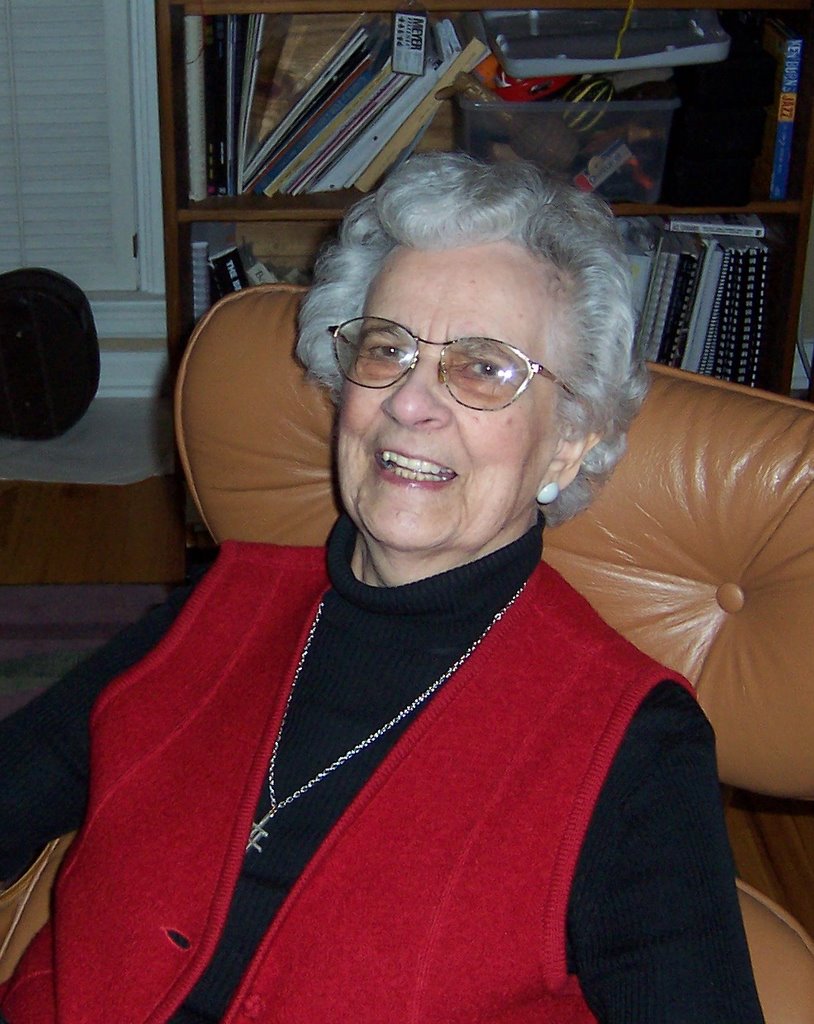
Grandma

A few weeks ago, after a long illness, Thedford Dirkse, the husband of my maternal grandmother ("Great Ted," the kids called him), joined the Church triumphant.

The days surrounding his death I spent with family -- especially with my Grandma. The funeral was really quite good (a solid sermon, a comforting prayer, and dixie-land trumpet playing "When the Saints Come Marching In"). And there was something fitting about the cold fall day we interred his body; after the morning ceremony, I worked the rest of the day in the yard, putting other things in the ground in hope of new life in the not-so-distant future.

We know God works all things for good -- and one good thing to come from Ted's death is that we are spending lots of time these days with Grandma. She comes for dinner at least once a week, and we get to see her some weekends, too. She is a lively conversationalist, a wise and godly woman, and she enjoys rather than shuns the sometimes...shall we say... vigorous sociability of the children.

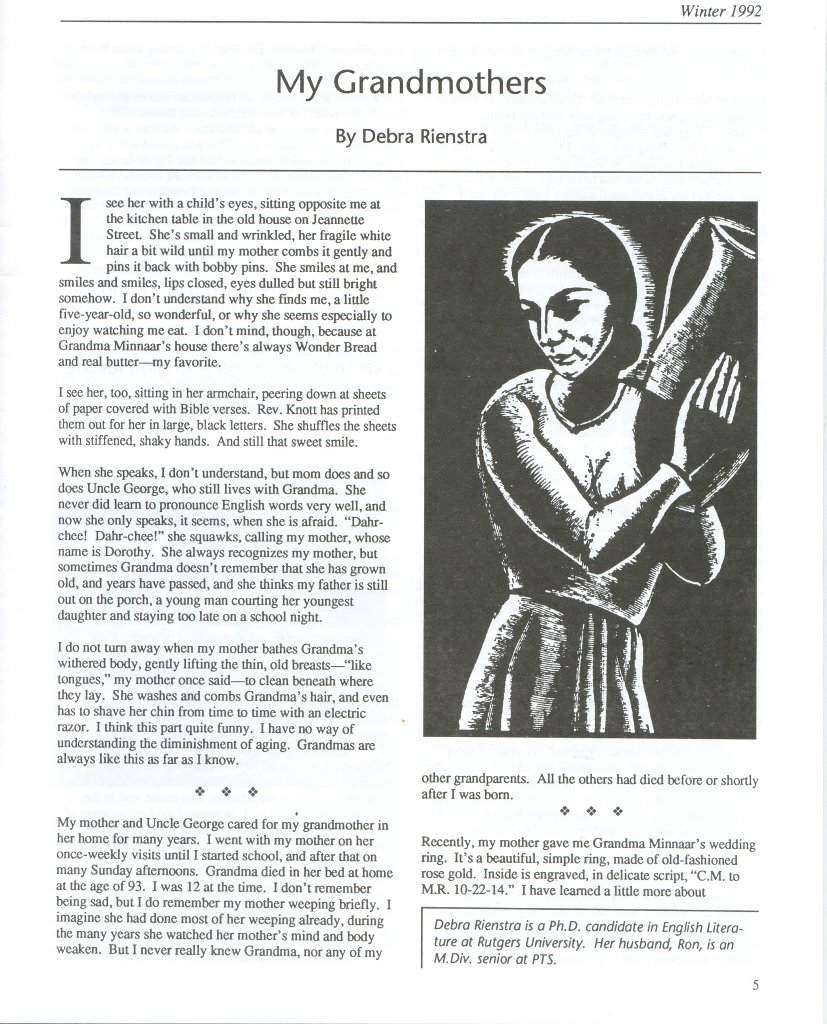
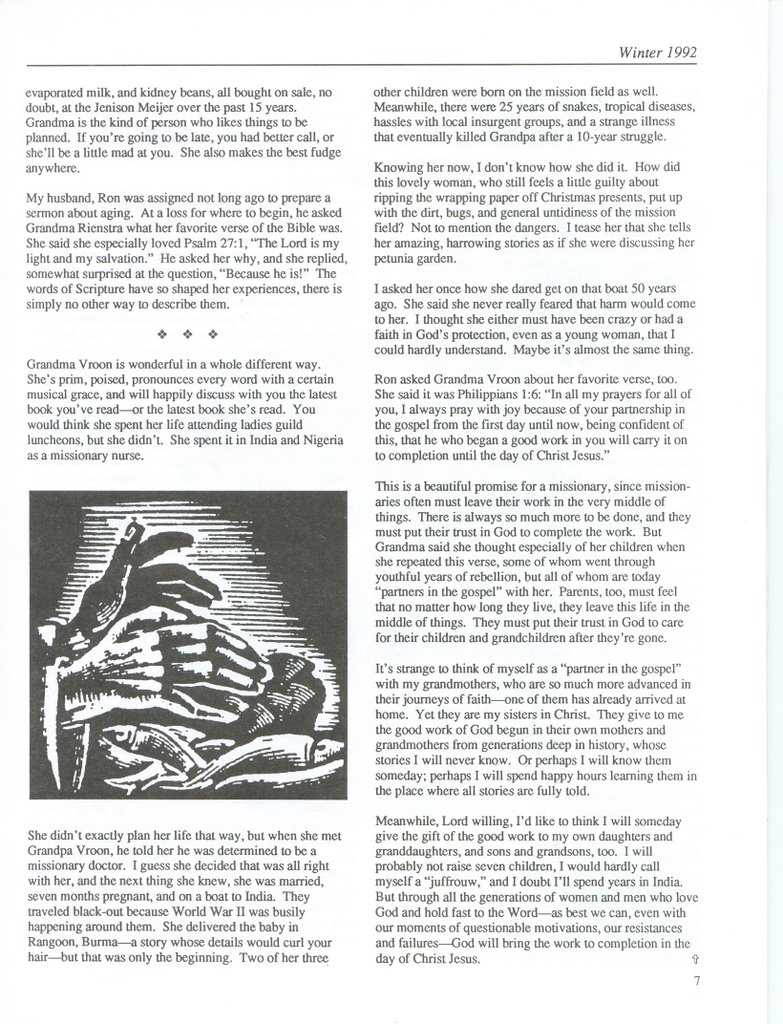
I was thinking about what a great woman she is when I remembered a piece Debra wrote 15 years ago (the last time I was in grad school!) for a Princeton Seminary community publication called Testament. It's about grandmothers -- Debra's own, and the two she inherited when she married me. I looked it up in our files, and thought it deserved to see the light of day again, in honor of one great Grandma. (Click on the thumbnails for a readable size .jpg file.)


My one ambition for my old age is to be a church lady. Not the kind who has turned bitter, complaining, and judgmental, but the kind who has grown nearer to wisdom and peace. I will be the lady in the same pew (or whatever we sit on by then) every Sunday, and I'll know all the little kids' names. I'll show up at the potlucks and volunteer to tutor the neighborhood kids. I'll sing loudly even though the people standing around me will secretly wish I had retired my voice years ago. Mostly I will pray, pray for people even when they haven't asked for prayer.
-- Debra Rienstra, So Much More, p. 181

Tuesday, August 08, 2006

Splish Splash

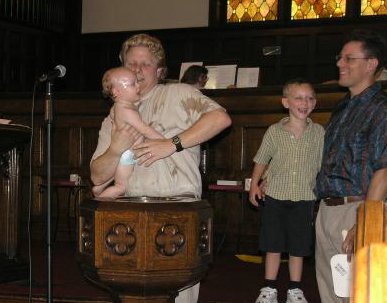
A couple weekends ago the whole family went to Chicago for the baptism of my namesake nephew, Samuel Ronald. John and Michelle honored me by inviting me to perform the baptism, along with their own pastor, at their own church, Pilgrim Congregational in Oak Park.

At their request, we splashed Sammie good with freshly imported water from Lake Michigan. As I looked at the somewhat murky pitcherful on the table, I thought that we were certainly following the ancient advice to use "living" water when baptizing (that's Johnny and his oldest, Gabriel, laughing at the abundant moisture).

John and Michelle (Sammie's parents) were eager to use real Lake Michigan water for the baptism because both sides of the family have summer cottages and deep connections to the "Big Lake" as home. So in the service I pointed to the link between family initiation and initiation into the larger family of God.

But more than that, I suggested that using water from this natural resource -- so dominant and precious to us in the midwest -- highlights the deep connection between the grace of God offered in baptism and the responsibility we gratefully take on as Christ's disciples to care for the world in which that grace is manifest. It says something damning to us if the water in our great lakes (or backyard streams, or rivers, or oceans) is so polluted that we cannot in good common sense bathe in it, or in good conscience call it "living" water. Perhaps my nephew Samuel will grow up, in service to Jesus, to be a biologist who concerns himself with the health of Lakes Michigan, Superior, Huron, Ontario, and Erie.