Monday, February 27, 2006

Laughin' at Laughlin


The whole family spent this past weekend in Laughlin, Nevada. Three guesses what drew us out into the desert (cheaters can scroll down).

We decided that Laughlin is sort of a beginner LasVegas; it's got bright lights and casino gambling and theatrical productions of dubious moral value -- the same as you'll find a few miles to the north, but they're here on a much smaller, even shabbier scale. If you sort of squint your eyes and look at the strip (see picture above), you might indeed believe you're in Sin City. Of course, squinting is a good idea anyway when you enter the smoke-hazed casino and find that you're looking at a room full of old, lonely, overweight people, chain-smoking and drinking and feeding slot machines all day and night. In fact, you'd have to squint really hard to see what the casinos want you to see.

We had a fun drive down, including a hilarious few minutes as we were leaving L.A. on the 210. There were only about 2.7 buzillion other people on the road with us, and as we went underneath a long overpass (which took a good long time), people began sounding their horns -- maybe to hear the echo, maybe to let off some steam, maybe just because it was Friday and they were heading out of town. It was random and social and funny - like a flash mob. In all the noise we heard the obligatory call-and-response "shave and a haircut" many times. Others just cheerfully peeped random rhythms. We joined in the honk-fest and then laughed about it for miles afterwards.

But as astute readers will already know, we did not leave L.A. and endure traffic of apocalyptic proportions in order to see the natural beauty of the Mojave desert, nor to gamble away my teaching fellowship fundage. Instead we went to see Mia's superlative soccer team kick some non-California competition. We all got a good laugh out of a first-game snafu: Mia had accidentally brought along Jacob's all-star soccer jersey instead of her own (all the Burbank teams wear the same style jersey). This meant that our team had two players labeled #11. So we got some painter's masking tape and covered up one of the ones, and Mia played. But the other team complained to the referee about "that player with the unusual shirt." They thought she was a ringer, because she was, in their words, "too tall and strong and fast" to be under 14 years old. (She is strong and fast, but tall? She's average on her team. Not to mention their team.) I think they were looking for some excuse to protest the drubbing they received. Final score: 6-0.

After that cake-walk, there were two other tougher games -- one scoreless draw, and one hard-fought win at 3-0. In the tie game, Mia managed to jump up for a header and collide heads in mid-air with an opposing player. Mia came down hurting but kept focus and continued the play. The other gal didn't fare as well. We saw her the next day -- still playing, thank goodness -- but with bruising around her eye shaped suspiciously like a Mia-head-print. Mia said afterwards that she felt really bad, but then again the girl should've just gotten out of the way and let Mia head the ball, and then she wouldn't have gotten hurt. Simple!

In the championship game, Mia's team dominated the offensive play, yet squeaked by with a 1-0 win. Still, a win is a win, the bling-bling is just as bright. And the parents are just as thrilled to see the girls' laughing faces as they come through the "way-to-go!" lineup at the game's conclusion.


(by the way, the mysterious blonde in the picture at the top of this post is a member of Mia's team, Danielle Reid)

Friday, February 24, 2006

Boundlessly Stupid

My friend Bethany Keeley rants on her blog about an article she read in the Focus on the Family webzine, “Boundless.” This ‘zine is aimed at “single adults,” and touts itself as as a place to explore “love beyond sex, faith beyond sociological stereotypes, and ideas beyond the politically correct.” It does not say anything about exploring (or embracing, as the article does) gender essentialism beyond question, historical generalizations beyond research, and conclusions beyond logic.

I loved Bethany's critique. But I also thought her words were too measured, too generous, too charitable to be called a “rant.” When you're in academia, and you're in a fight worth fighting, you need to bring it. Bethany is a first-rate grad student in communications, but she's also in her first year. I give her another six months before she's learned the true grad school art of opening up a big can of rhetorical whup-a**.

Two further comments. First, I was astonished to read that Maken was a lawyer before the end of her “involuntary servitude to singleness.” Don't they teach logic or research or history any more in law school? I was reading the piece aloud to Deb last night -- the kids were in the room, too, working on craft projects. We were howling in laughter as Jacob picked up on our real-time critique, and whenever Maken made sweeping and unsupported generalizations like “…past generations of Christians…” or “the purposes of marriage were uniformly understood…” or “Today’s singleness is either a lifestyle option or purely circumstantial; therefore it is largely unbiblical,” he would grab a piece of red paper from the craft project he was working on and wave it aloft, as if to say: “Red flag! Warning! Crashing non sequitur ahead! Caution! Facile conclusion just off the starboard bow!”

Second, I am dismayed that anyone is slurping up this stuff. Debra has been giving talks lately at Christian colleges – sometimes solo, sometimes with me along – on issues of feminism and family and career and vocation. Our hearts hurt for the good and godly young people at these places who uncritically accept the Dobsonian party line on “family values.” And our hearts are also proud of places like Calvin College, in whose educational fire God shapes thoughtful young women like Bethany. You go girl! Bring it!

Monday, February 20, 2006

Foothold

Among Debra's many accolades, we can now add this: published hymn-writer. She recently entered -- and won -- a hymn search contest held at Fuller Seminary. One purpose of the song was to commemorate the Fortieth Anniversary of the School of Psychology. Another was to articulate something about trust in God for healing. Finally, the theme of the worship service at which the hymn would debut was "Looking back, looking ahead." Thus, a hymn that shot an arrow in that diretion would get bonus points.

Deb thought Psalm 25 was an excellent expression of this sort of prayer, and so used it as a basis for her hymn text. She wrote it to be sung to the tune Kingsfold.

Here is the text and melody laid out, with chords hand-written above the staff. This harmonic arrangement of the tune is courtesy of the jazz pianist/preacher Bill Carter. To get a sense of the arrangement, click here for a very rough, homemade Mp3. The violinist is a particularly talented 10-year old, and the guitarist is, well, me.

We were part of that "Looking Back, Looking Ahead" service this past weekend where the hymn was first sung. Not only did we sing Deb's hymn, but I played the guitar on another song, and all the kids participated in a choir. Lovely. But the highlight of the service was something else altogether. At a certain point in the service, a somber fellow read aloud the names of alumni, trustees, and faculty of the school of Psychology who had died since the founding of the school. At each name, a loud, beautiful bell sounded one note. The best part: a cherubic little infant, maybe a year old, cooing with glee at each peal of the bell. Looking Back, Looking Ahead indeed.

Saturday, February 18, 2006

Big boy biker


Already in England, when he was four, Pip was begging me to teach him to ride a "big boy bike" -- i.e. a two-wheeler without training wheels. We didn't have a bike for him then, and we've been relatively busy since, what with moving to California and all. And there's really no good place to ride here in Sunland, auto reclamation capital of Southern California.

But he got it into his head again last week that he wanted to learn to ride. So he's spent a bit of time working on his balance on his own, practicing in what passes for our "driveway" here -- all 20 yards of it. Today I took him to the church parking lot, took off the training wheels, and was ready to tell him what he needed to know: keep pedaling, you're doing a great job, hold the handlebars steady, you're doing a great job, lean into the turn, you're doing a great job, watch out for that tree, you're doing a great job.

Well, I got the bike out of the car, put it down on the pavement, and turned my back for a minute to get my sunglasses and soda. I turned around, and there was Pip, already aboard and pedaling like a pro right from the start. He tooled around the parking lot like he'd been doing it his whole life. "Hey!" I yelled... "Um.... Er.... You're doing a great job!"

Monday, February 13, 2006

Olympic Events We'd Like to See

OK, after a weekend of TV watching as a family, we have decided that we're completely down with some of the funky sporting events that are part of the Olympic games these days. The summer games have stuff like fencing and speed walking and synchronized swimming. And the winter games have to keep up, so they have sports like curling and ice dancing. And I like the Biathlon. I really do. I think Dick Cheney should enter.

But if we're going to just open the door to any old crazy thing kids do these days and call it a sport (read: half-pipe snowboarding), then may I propose the following events we'd really like to see, and invite my readers to suggest their own experimental Winter Olympic Events:
  • Cross-Country Polar-bear escape
  • Bobsled Chicken
  • Ice sculpting w/ chainsaws
  • The Bikini downhill (or the G-string Super-G)
  • Ice fishing (beer companies lining up to sponsor this one)
  • Soccer on ice-skates (everything's a little more fun tried on slippery ice)

Wednesday, February 08, 2006

Drama in Worship

An upcoming speaker for All-Seminary chapel here at Fuller has asked my interns to make use of drama in the worship service. So they asked me for a few pointers -- some do's and don't's, with theological underpinnings. I obliged with a discussion prompted by the following excerpt from something I'd written a while ago, and which I have just learned has been sent to the printers and so at this moment is being published. Hooray!

(For more info on this publication, see here and here.)

...[W]e need more drama. Not a light-hearted warm-up to the sermon, not a subtlety-deficient morality lesson – a good hard thwack in the ethics – but something that provokes and asks questions, that genuinely invites the congregation into a space where the text and our unique lives intersect.

Of course, all congregations use drama in worship. Scripture read with passion and intelligence is drama. A song that tells the salvation story is drama. Worship as a whole is drama. The best worship services, the best liturgies, are those that re-enact the drama of God and God’s people, traversing the contours of the covenant life. For that very reason, other “mini” dramas, inserted into the liturgy, can distract from the primary work of the people. Yet thoughtful, well-written drama can be used fruitfully in worship: to point out paradox or hypocrisy, to deepen confession, to give expression to anguish, to testify to unmerited grace. It can illumine places where the changeless Gospel intersects with our changing times. In a world becoming less literate and more oral and aural, drama is a powerful – and often overlooked – tool for proclaiming that Gospel.

... Still, the wise pastor will make sure that materials used in worship are reviewed by someone with theological discernment, who knows a good heresy when she sees one, who knows to avoid moralistic shlock and propagandistic screeds, who shuns the quick laugh and uninformed improvisation; someone who knows that part of the power of drama in worship is its poetic character, the concentrated, careful use of words – always in service of the One Word.


Sunday, February 05, 2006

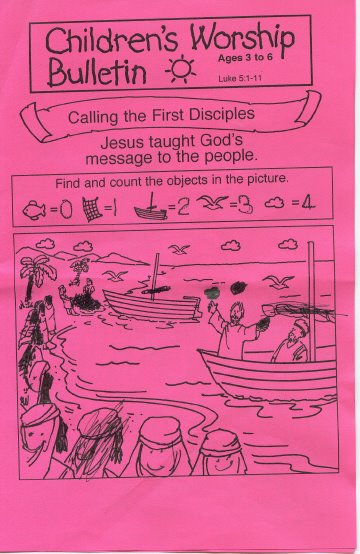
Philip's Advice for Preachers

So today at church Philip is drawing on his children's bulletin during the sermon. I see that it is a picture of Jesus in a boat on the Sea of Galilee, preaching to the crowds. Philip has drawn some dark blobs near his hands. "What are these, Pip?" I whisper. "Those are rubber balls," he says. "Jesus is juggling."

Hmmm. The rest of us preachers are in real trouble if Jesus has to resort to juggling to keep the congregation's interest.

Saturday, February 04, 2006

Latest Tabloid Gossip

Most of the readers of this blog will have already received our annual family publication in the mail by now. We Rienstras, ever the non-conformists, don't do a "Christmas" letter. We send out our yearly news and greeting in Epiphany, because we're just too busy during Christmas. Bah humbug.

We also don't do content in the usual way. Actually, we hardly do content at all. But our friends are too polite to mention that they have a hard time discerning any real information about us from an elementary school homework sheet, a fictional book review list, an allegorical map, or any of the other wild ideas we've come up with. But hey, is information the point?

So this year we figured that our letter should reflect a bit of L.A. celebrity culture. Thus, we have produced a mini-tabloid, the SUN Valley News. If you don't have your own copy, you can see it here.

Wednesday, February 01, 2006

The Fishing's So Good They're Practically Jumping into the Boat

I was helping Mia do a science project last night, and she wanted to see if we could find a picture of the world's largest freshwater fish -- the Giant Mekong Catfish. Sure enough. Found one. (For more, click here, here, and here.)

Then I found a video of some supernaturally great fishing. You will not believe it. Check it out here.

Then shudder at the prospect if these two worlds collide.

Sunday, January 29, 2006

2006 Sym-poser...eeh...um....

We've just finished a splendid weekend in Grand Rapids at the 2006 Worship Symposium. It was delightful to see so many of our friends and colleagues, and the conference itself was, as usual, thought-provoking and inspiring. On top of that it was nice to be away - just Deb and I - while our good friends the Klaasens took care of our progeny.

Debra and I were both presenting at this year's conference. My stock rose considerably in the eyes of some of my worship wonk friends who for the first time this year were introduced to Deb. If I had a nickel for every time someone came up to me and exclaimed how fabulous Deb's presentations were, how insightful her comments, how engaging as a speaker and brilliant as a writer... Well, it would be a nice chunk of change.

My own presentations went well, too -- increasingly so as the weekend progressed. I felt like I really nailed my key presentation by the third time I gave it. I always feel a little insecure about my own material - like half-way through someone is liable to stand up and say: "What you're talking about is so obvious! What kind of fraud are you?!?" But no one did (though there was a grouchy lady in the back row in my second section staring daggers at me the whole time) and in fact, some people had nice things to say.

I basically encouraged worship planners to think about our services as "practice" for life. We do drills in church that isolate particular crucial Christian skills -- confessing sin, attributing beauty to God, lamenting brokenness, praising etc. These are the skills we need as we live the "game" of our Monday-through-Saturday lives.

Borrowing on my experience as an AYSO soccer coach and my membership in a certified Suzuki violin family, I compared planning worship to planning soccer practice and violin practice. There are different ways to work on a particular skill set; some drills work better than others. So how can we modify our worship drills, I asked, so that we are more effectively shaping our wills, ordering our affections, and instilling information? How do we go about shaping our orthodoxy, orthopraxy, and orthpathy?

My section participants come up with some really good stuff: modifications and introductions to common liturgical actions to help focus our work. For example, applying theological filters to our congregational song repertoire to try to give us a healthy song diet; connecting our congregational offering with testimonies about personal and congregational efforts to help the poor and the outsider. We also talked about ways to use liturgical language in real life: At a wake: "The Peace of Christ be with you"; singing "Let us give our thanks and praise, it is right to give our thanks and praise" as a dinnertime grace. When telling a student who is failing your course that not all career doors are open to all people: "This is the Word of the Lord."

Tuesday, January 24, 2006

Hardware Drives Software: Technology & Music in Worship

Last week I finished writing a piece for Fuller Seminary's 3x-yearly magazine of theology & commentary, Theology News & Notes. This particular issue's theme is the place of music in worship, and I was asked to contribute a piece on the effect of technology on worship music. My thesis, simply put, is a truism borrowed from the computer industry -- hardware drives software:

As the church seeks to make the most of certain hardware technology – amplification, lyric projection, and looping DJ software, for example – we can expect that our worship software, i.e. the style of our worship itself, will also change. It may expand in potentially wonderful and creatively enculturated new ways, following the leading of the Holy Spirit. Or it may be narrowed in ways that are hip, but historically, and even theologically, suspect.

The article then examines the three aforementioned technologies, pointing out the good and the bad, the helpful and the heinous.

The idea for the piece arose arose out of a seed of an observation about hardware and software and the composition of some contemporary worship songs:

I have begun to see signs that some songs are being composed, perhaps unconsciously, not just to take advantage of the technology, but bounded by its peculiar limitations. The structure of the songs and the shape of the melodies are being molded to fit the size of the screen and the super-sized words projected onto it. Thus, we no longer get lyrical lines of melody and text; we get textual phraselets and melodic motifs -- mere musical fragments, not bearing repetition, but repeated nevertheless. And repeated.

A good example is the song “My Glorious” by Martin Smith and Steward Garrard....

Lest I appear a Luddite here, I hasten to add that in the article I have many good things to say about amplification, projection, and yes, DJ looping software. But I am concerned that we are less discerning than we might be. I challenge you, for example, to visit this website and find a single theological insight brought to bear on the use of technology in worship. Sigh. There's a lot of work to be done.

I am quite interested in hearing from my fellow WorshipWonks who read this blog: what effects on worship style/software do you see as a result of the church's adoption/adaptation of certain hardware technologies?